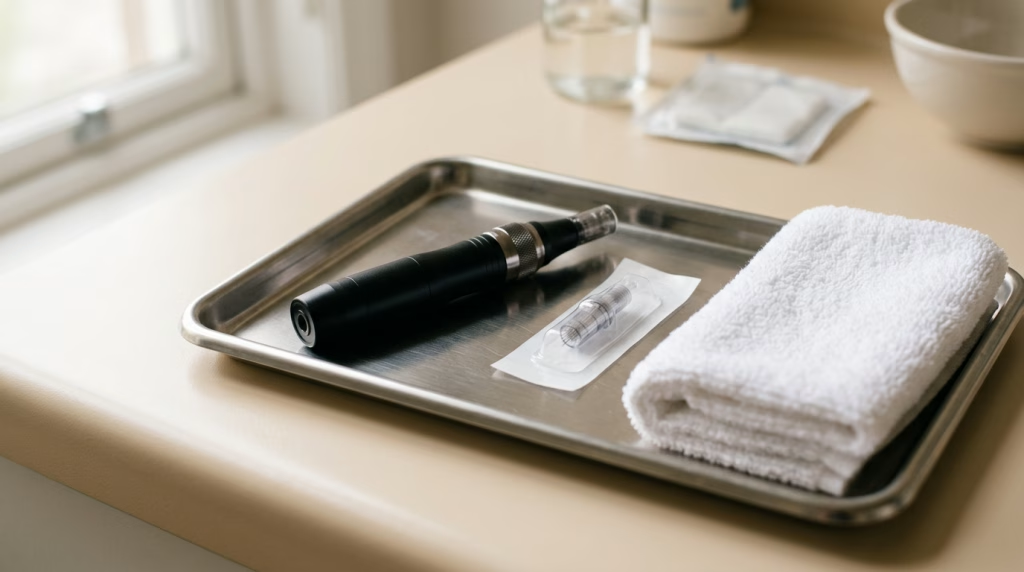
People search for microneedling before and after expecting a quick fix. That’s the wrong lens. I’m Natasha, sole practitioner at House of Glam HQ in Southsea, Portsmouth, and after 7+ years in clinic, I can tell you the useful result is usually steadier than the internet makes it look. Microneedling works by prompting your skin to rebuild its own collagen, so the “after” develops over weeks and months, not overnight. The visible change is usually smoother texture, softer scarring, and better skin quality, with the biggest shift appearing as a course builds rather than after one appointment. If you want the honest version of what that timeline looks like, this is it.
Table of Contents
- 1. For Acne Scarring Especially Rolling and Boxcar Scars
- 2. For Fine Lines and Early Signs of Ageing
- 3. For General Texture, Tone, and Enlarged-Looking Pores
- 4. Why It’s a Course of Treatments, Not a One-Off
- 5. Pre-Treatment Prep Setting Your Skin Up for Success
- 6. Post-Treatment Care How to Protect Your Result
- Microneedling Before & After: 6-Point Comparison
- Is Microneedling Right for Your Skin?
1. For Acne Scarring Especially Rolling and Boxcar Scars

Acne scarring is one of the main reasons people ask me about microneedling, and rolling and boxcar scars are often the clearest fit. Those indented scars need support rebuilt underneath them. Microneedling creates controlled micro-injuries, then the skin responds by laying down fresh collagen over time, which can lift the base of the scar a little and make the surface look smoother.
The catch is that scar type matters. Deep ice-pick scars are much harder to shift, and I would never tell someone they will disappear with microneedling alone. If a client comes in expecting a total reset, I pull that back straight away, because the result here is improvement, not erasure.
That usually means patience and the right plan. In practice, I judge acne scar work by how the skin settles across the course, how the edges soften, and whether the change is useful in real life rather than just impressive in a photo. If you want a fuller breakdown of which scar types suit treatment, the honest guide to acne scarring covers that in more detail.
The clinical picture matches what I see in the room. A large scar study reported that patients had 1 to 6 monthly microneedling sessions, and all scars improved at least 50% after an average of 2.5 treatments. More than 80% achieved 50% to 75% improvement, and 65% achieved more than 75% improvement in that study, with no significant response difference between facial and non-facial scars or between acne, traumatic, and surgical scars (study details). I do not use those figures to promise the same outcome for every face, because skin response varies, but they do explain why I do not judge acne scarring by the first session. I look at the full course, and I pay attention to whether the scar depth is changing in a way that holds up.
Practical rule: if the scar is indented and textural, microneedling often has a place. If the scar is very deep and narrow, I usually say we need a different plan or a combination approach.
I would rather give someone measured progress than sell a fantasy.
2. For Fine Lines and Early Signs of Ageing

Fine lines are where people sometimes expect a filler-style jump, and microneedling does not work like that. It will not add volume, and it does not freeze movement like wrinkle relaxing injections. It improves the skin itself by nudging collagen and elastin production, so the surface looks a bit firmer, fresher, and better supported.
That is why the before and after tends to look like a softer, better-rested face rather than a different face. Around the eye area, around the mouth, and across the cheeks, fine lines usually become less obvious as skin quality improves across a course. The change is gradual. That is exactly why it feels believable in real life.
A U.S. prospective facial and neck trial found that by 3 months, facial dermal density rose 101.86%, epidermal density rose 19.28%, facial elasticity increased 28.2%, and attenuation coefficient improved 15.65% at 1 month and 17.33% at 3 months (trial data). I am not using those figures to promise the same result for every client, because skin response varies, but they do show the same core point I see in clinic. The improvement is structural, and it keeps unfolding after the appointment itself.
If someone’s main concern is movement lines and they want a faster muscular relaxation effect, I point them towards wrinkle relaxing injections instead. If their issue is early ageing plus roughness, dullness, or shallow lines, microneedling can be the better fit.
3. For General Texture, Tone, and Enlarged-Looking Pores

Sometimes the complaint is not a scar or a line. It is the overall surface, roughness, dullness, enlarged-looking pores, patchy tone, that slightly tired look that makes skin feel less polished. Microneedling suits that well because it improves texture from the inside out, so the skin starts looking more even as the healing response settles.
I see this most often with people who say makeup catches in the same areas every day. Around the nose, on the cheeks, along the forehead, those pores do not disappear, but they can look less prominent when the surrounding skin feels firmer and smoother. That is the kind of “after” that matters in real life, because it changes how skin behaves under makeup and daylight.
The trade-off is simple. Microneedling can improve the appearance of texture, tone, and pore visibility, but it will not add volume or instantly blur every mark. It is a repair-led treatment, not a surface disguise. If the skin is already inflamed or heavily sensitised, I usually hold off until it is calmer, because starting on irritated skin gives you a worse experience and a messier result.
For people who mainly want honest advice on pore reduction, microneedling can be part of the answer, especially when the concern is texture plus enlarged-looking pores rather than one isolated problem. In practice, those clients often care less about a close-up photo and more about whether their skin looks more settled in daylight, which is the better test anyway.
The useful question is not, “Did the pores vanish?” It is, “Does the skin look smoother, cleaner, and easier to wear without makeup?” That is the real microneedling before and after conversation.
4. Why It’s a Course of Treatments, Not a One-Off
Microneedling works because the skin is being asked to repair itself, and repair takes time. That is why I never treat it as a one-and-done appointment for a specific concern. Collagen keeps building for roughly 3 to 6 months after treatment, and one UK-based study found visible benefits were significant at 90 and 150 days after the first session, with four facial treatments spaced 4 weeks apart producing mean improvements by Day 150 in global wrinkle score, skin laxity, and skin texture (UK clinical evidence). People need that timeline before they start judging a result from an early photo.
Spacing matters because each session depends on the last one. A medical review describes sessions lasting 10 to 20 minutes depending on the area, patients usually returning to daily work the next day, and multiple sittings commonly spaced 3 to 8 weeks apart (review evidence). In clinic, I usually plan around 4 to 6 weeks between sessions, but I do not force every face into the same rhythm, because skin response is individual and the pace should match the concern.
I’m blunt about the trade-off. If someone wants a clear shift in texture or scarring, pushing sessions too close together usually works against the outcome. The skin needs time to finish one repair cycle before the next controlled injury is added. Texture and glow can sometimes respond in fewer sessions, while scarring usually needs the fuller course and a bit more patience.
For clients who want to understand the pace that suits their skin, my optimal microneedling for skin concerns page is the right place to start. Maintenance later on is often part of keeping the result steady.
5. Pre-Treatment Prep Setting Your Skin Up for Success
Before microneedling, I want the skin calm, clean, and not already irritated. That part is straightforward. A few days before your appointment, stop strong actives like retinol, glycolic acid, and salicylic acid, avoid sun exposure, and don’t arrive with a tan or fake tan on the area. Come in with a clean face, free of makeup, so I can assess the skin properly and work on a clean surface.
I also want cold sores flagged early. If you get them, tell me before treatment, because microneedling can trigger them. Active acne is another case where I’ll pause and assess first. If the skin is inflamed, it needs settling before I start needling it.
The simplest way to think about prep is direct. Don’t sensitise the skin before we even begin.
- Pause strong actives early: retinol and exfoliating acids need a break so the barrier is not already irritated.
- Avoid UV and tanning: sun exposure and fake tan can make treatment unsuitable on the day.
- Arrive with clean skin: no makeup, no residue, no last-minute layering.
- Tell me about cold sores: if there is a history, I need to know before I treat.
For anyone booking a microneedling treatment, the pre-appointment conversation matters. It is how I check suitability, talk through the likely result, and make sure we are not pushing skin that needs a rest first. That is better than pretending every face is ready for needling on every day.
6. Post-Treatment Care How to Protect Your Result
The first 24 to 48 hours after microneedling are about healing, not showing off the result. Keep it simple. No makeup, no active skincare, no sauna, no hot workouts, and no direct sun. NHS patient guidance from Chelsea and Westminster notes redness and swelling can last days after treatment, and that early redness shouldn’t be mistaken for the final outcome (NHS patient guidance). That’s one reason I’m strict about the first couple of days.
Daily SPF is the big one after that. Freshly needled skin is more vulnerable to sun and pigmentation, and the sun will work against the collagen you’re trying to build. If someone spends money on a course and then skips sun protection, they’re undercutting the result. I’d rather say that plainly than soften it.
A few sensible habits make the difference between a skin-friendly recovery and a grumpy one.
Practical rule: if it stings, stirs redness, or strips the skin, leave it out for now. Gentle wins the first week.
- Keep hydration up: water and a basic, barrier-friendly routine help the skin settle.
- Don’t pick or exfoliate: flaking skin needs to come off on its own.
- Ease back slowly: return to normal products after a couple of days, not immediately.
- Watch heat and sweat: both can prolong discomfort right after treatment.
I provide written aftercare, and I’m reachable if anything feels off. That aftercare window is where people protect what they’ve paid for, and it’s one of the main reasons results hold up better across the course.
Microneedling Before & After: 6-Point Comparison
| Item | Implementation complexity | Resource requirements | Expected outcomes | Ideal use cases | Key advantages |
|---|---|---|---|---|---|
| Acne Scarring (Rolling & Boxcar) | Moderate–high: precise needling depth and multiple sessions | Qualified practitioner, ~6 sessions typical, downtime between treatments | Gradual collagen rebuilding; raised scar bases and smoother texture (not full removal) | Indented textural scars (rolling, boxcar) | Stimulates internal collagen repair; noticeable texture improvement |
| Fine Lines & Early Ageing | Moderate: repeated treatments over months | Practitioner-led sessions (3–6), cumulative timeline up to 12 weeks post-session | Progressive skin plumping, firmer texture, softened fine lines | Early ageing, superficial lines, loss of firmness | Improves skin quality without muscle paralysis; long-term resilience |
| General Texture, Tone & Enlarged Pores | Low–moderate: less aggressive protocol than scar treatment | Short course (~3 sessions), minimal downtime | Smoother surface, more even tone, reduced appearance of enlarged pores | Rough texture, dull skin, visibly large pores | Resets skin texture and radiance; firms pore walls |
| Course of Treatments (Treatment Plan) | Moderate: requires scheduling and adherence | Multiple sessions spaced 4–6 weeks; maintenance visits 6–12 months | Cumulative and longer-lasting improvements in skin quality | Any goal needing structural change (scars, lines, texture) | Builds on prior results; trains skin’s healing/remodeling process |
| Pre-Treatment Prep | Low: simple behavioural and product adjustments | Stop retinoids/acids 3–5 days, avoid sun/tan, disclose cold sore history | Reduced risk of irritation, safer and more effective treatment | All microneedling clients | Lowers complication risk; optimizes skin readiness |
| Post-Treatment Care | Low–moderate: strict short-term rules | Gentle cleanser/hydrator, avoid makeup/exercise 24–48h, daily high‑factor SPF | Protected new collagen, reduced pigmentation risk, better long-term results | All clients after every session | Preserves results and prevents complications; essential for outcomes |
Is Microneedling Right for Your Skin?
The best microneedling before and after result is a realistic one. It starts with the right concern, the right skin condition, and the right timeline, not with a filtered photo. If you’ve got rolling or boxcar acne scars, early fine lines, or texture that just looks tired and uneven, microneedling can be a solid option. If you’re dealing with deep ice-pick scarring, active acne, or you’re hoping for a quick overnight change, I’d rather tell you now that it may not be the right first step.
That honesty matters because this treatment is about improvement, not cure. It improves the appearance of the skin by triggering collagen and elastin production, and that process keeps unfolding for months. In a consultation, I’ll look at your skin properly, talk through what’s realistic, and map out whether a course of treatments makes sense for you. Pricing is £80 for a single face session, with a course of 3 at £215 and a course of 6 at £410, and the starting point is always the same, a clear conversation.
You’ll also get straight answers about whether a short course, a fuller run, or a different treatment altogether is the better fit. I’d rather be honest and useful than promising a result your skin can’t sensibly deliver. That’s how you get a better outcome, and a calmer one.
If you’re ready to see what microneedling could realistically do for your skin, visit House of Glam HQ and book a consultation. I’ll talk you through the likely timeline, the right treatment plan, and whether microneedling is the best next step for your skin in Southsea, Portsmouth.

