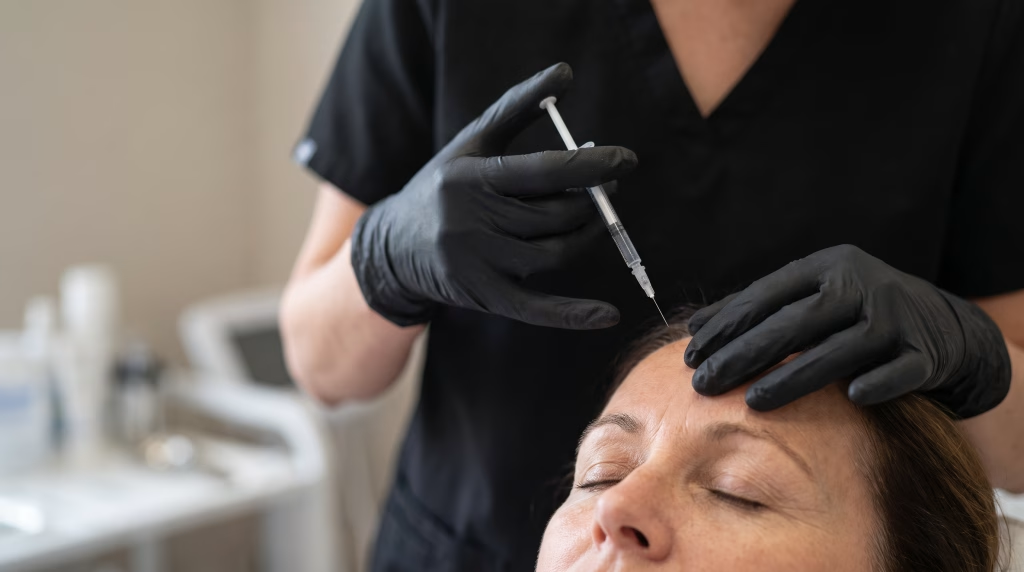
You’re sitting across from an injector, pointing to the lines beside your mouth or the hollow beneath your eyes, and asking for anti-wrinkle injections because you want everything smoothed. That’s a very common starting point. But facial lines don’t all come from the same cause, so the treatment that works beautifully on a forehead crease may do very little for a fold created by lost volume.
I’m Natasha, sole practitioner at House of Glam HQ in Southsea, Portsmouth. With more than 7 years of clinical experience, I assess the concern in front of me rather than selling a product by name. The useful question is simple: is this a movement problem or a volume problem?
The Question I Get Asked Every Week in Clinic
A client may arrive, raise their eyebrows, and point to the lines that appear across their forehead. That’s usually a movement-led concern. Another client may relax their face, point to a nasolabial fold that remains visible, and ask for the same anti-wrinkle treatment. In that situation, muscle relaxation won’t replace the volume or support beneath the skin.
Anti-wrinkle injections, commonly known as Botox, the brand name for botulinum toxin, temporarily reduce targeted muscle activity. They’re suited to dynamic lines, meaning lines that appear or deepen when you frown, lift your brows or smile. Dermal fillers use a gel, commonly hyaluronic acid, to add volume beneath the skin and support areas such as the lips, cheeks, chin or deeper folds.
My consultation rule: I treat the anatomical cause, not the loudest line in the mirror.
This distinction matters because choosing the wrong treatment can leave you disappointed and out of pocket. Anti-wrinkle injections won’t fill a hollow. Filler won’t stop a forehead muscle contracting. A fold can also have more than one cause, which is why some patients benefit from a staged plan involving both treatments.
The most useful first step is the mirror test. Look at your face in natural light while relaxed, then frown, raise your brows and smile. If the line appears mainly with movement, anti-wrinkle injections may be appropriate. If the shadow or crease remains at rest, we need to assess volume, tissue support and skin quality.
In my Southsea clinic, the consultation also covers your medical history, expectations, previous treatments and whether an injectable is suitable at all. Sometimes the right advice is to start with a skin treatment, leave the area alone or seek medical assessment. A responsible injector should be comfortable saying that.
How Anti-Wrinkle Injections and Dermal Fillers Actually Work
The two treatments may both involve a needle, but they work in opposite ways. One reduces muscle contraction. The other adds volume and structural support.
Anti-wrinkle injections
Botulinum toxin temporarily reduces the nerve signal that tells a selected muscle to contract. With less contraction, the skin above that muscle creases less forcefully. That’s why treatment is commonly considered for forehead lines, frown lines and crow’s feet, alongside advanced areas such as a brow lift, bunny lines, chin dimpling or masseter treatment.
The result should still allow natural expression. The aim isn’t to make every part of the face immobile, and an injector has to account for muscle strength, brow position, facial balance and the way you naturally communicate.
Dermal fillers
Most fillers used for facial contouring are hyaluronic-acid gels. They sit beneath the skin to restore volume, improve projection or support a fold. Depending on the product’s characteristics and the tissue depth, a practitioner may use filler for lips, cheeks, chin, jawline, nasolabial folds, marionette lines or a non-surgical nose treatment.
In the UK, Parliament’s briefing states that hyaluronic-acid dermal fillers typically last 6 to 18 months and explains that fillers add volume, while botulinum toxin temporarily relaxes muscle-driven wrinkles. You can read the Parliamentary briefing on botulinum toxin and cosmetic fillers for the distinction and the relevant legal background.
| Feature | Anti-Wrinkle Injections | Dermal Fillers |
|---|---|---|
| Mechanism | Temporarily reduces targeted muscle contraction | Adds hyaluronic-acid volume beneath the skin |
| Best suited to | Dynamic forehead lines, frown lines and crow’s feet | Lost volume, folds, lip fullness and facial contour |
| Common areas | Forehead, frown area, eye lines, brow, chin and masseter | Lips, cheeks, chin, jawline, nasolabial and marionette areas |
| What it doesn’t do | Add volume or replace structural support | Freeze expression or correct every movement line |
| Typical result pattern | Gradual onset | Immediate visible change, followed by settling |
Product selection matters. Softer filler may suit a mobile area such as the lips, while a firmer formulation may be considered where projection or support is needed. At House of Glam HQ, I use CE-marked hyaluronic-acid products from reputable pharmaceutical suppliers, including Juvederm, Restylane and Belotero. They’re lidocaine-blended and can be dissolved with hyaluronidase when clinically appropriate.
For local treatment details, see anti-wrinkle injections Portsmouth.
What to Expect From Your Appointment and Recovery
An anti-wrinkle appointment starts with assessment and facial mapping. I ask you to make the expressions that concern you, check your resting face and discuss the outcome you want. The injection process itself is usually short, around 5 to 10 minutes, with the sensation described as small pinpricks.
The result isn’t immediate. UK guidance states that cosmetic botulinum toxin typically starts working in about 3 to 5 days, can take up to 2 weeks for the full effect and usually lasts around 3 to 4 months. At House of Glam HQ, I explain the expected progression clearly, then include a complimentary 14-day review so we can assess the settled result rather than judging too soon.

Filler appointments feel different
With filler, I assess the area, skin, symmetry and the surrounding facial structure before discussing the amount and product. Topical numbing may be suitable for some areas. Depending on the location and technique, I may use a needle or cannula, and the appointment includes careful placement rather than injecting a pre-decided amount.
Filler can look fuller straight away, but swelling may make the early result look more pronounced than the final outcome. Bruising, tenderness, redness and swelling are possible, particularly in mobile or highly vascular areas. Most dermal fillers are temporary, and UK government guidance gives a duration range of 6 months to 2 years, depending on the product and treatment. Hyaluronic-acid filler can also be broken down faster with hyaluronidase if correction is clinically needed, although that decision requires assessment.
Avoid booking immediately before an important event. Allow enough time for swelling and bruising to settle, and follow the written advice you receive. Anti-wrinkle aftercare commonly includes avoiding strenuous exercise and not lying down immediately after treatment, while filler aftercare focuses on protecting the treated area and monitoring symptoms.
For practical instructions, read the essential 24-hour aftercare rules from House of Glam HQ. I’ll also tell you when to contact me urgently rather than waiting for the review.
How to Decide Which Treatment You Actually Need
Start with your face at rest. Stand in natural light and look straight ahead. Then frown, raise your brows, squint and smile. Don’t pull the skin or judge the face from one carefully posed angle.
Use the mirror test
-
Lines that mainly appear during movement: These are more likely to be dynamic lines, so anti-wrinkle injections may be the relevant option.
-
Creases or shadows that remain at rest: These may relate to volume loss, tissue support or an established static line, which can make filler the more relevant discussion.
-
A mixture of both: A staged combination plan may make sense after an assessment.
Forehead lines, frown lines and crow’s feet commonly respond to muscle relaxation. Nasolabial folds, marionette lines, lip deflation, cheek hollowing and some contour concerns usually need a volume-led assessment. That doesn’t mean every fold should be filled. Sometimes supporting the cheek is more appropriate than injecting directly into the fold, and sometimes filler isn’t suitable for the area.

Ask three practical questions
-
Does the line appear mainly when I move? If yes, anti-wrinkle treatment may be the starting point.
-
Has the area lost fullness over time? If yes, dermal fillers may address the structural part of the concern.
-
Am I preventing movement lines or correcting volume loss? Prevention and correction can overlap, but they aren’t the same treatment objective.
Combining treatments can be sensible when the concerns are separate. For example, anti-wrinkle injections may soften frown movement, while filler may restore cheek support. I prefer staging rather than adding everything at once when swelling or changing muscle activity would make the final assessment harder.
A consultation is especially useful for under-eye hollows, nose treatment, temples and lower-face concerns. These areas need anatomical judgement, and a mirror test alone can’t confirm suitability.
Safety, Regulation and What to Ask Before You Book
The UK safety conversation can’t stop at “Botox or filler?” The practitioner, product supply chain, prescribing process and emergency plan matter just as much.
In England, it’s a criminal offence to inject botulinum toxin or cosmetic filler for cosmetic purposes into anyone under 18. Providers must verify age before booking or treatment, as set out in GOV.UK guidance for enforcement officers.
Anti-wrinkle injections require prescriber-led governance. The JCCP states that remote prescribing shouldn’t be used for non-surgical cosmetic use, and the product must be administered under appropriate clinical oversight. The JCCP also reported 38 cases of iatrogenic botulism in England between 4 June and 14 July 2025, linked to unlicensed or counterfeit botulinum toxin injections in non-clinical settings, as recorded in its professional safety update.
Fillers have a different regulatory and clinical risk profile. An MHRA freedom-of-information response recorded 305 dermal-filler adverse-event reports in 2019, 217 in 2020 and 195 in 2021 in its published response. UK government guidance lists risks including vascular occlusion, tissue necrosis, blindness, infection, granuloma, bruising and swelling, with higher-risk areas including the forehead, nose, lips and around the eyes.
Questions I expect patients to ask
-
Who is prescribing the anti-wrinkle product? You should understand the prescriber-led process.
-
Which product will be used? Ask about the brand, formulation and traceable supply.
-
What happens if there’s a complication? The provider should explain the response pathway, not dismiss the question.
-
Where will treatment take place? A fixed, clean clinical setting gives you a clear point of contact.
-
What follow-up is included? You should know who reviews the result and when.
The MHRA explains that dermal fillers making medical claims are regulated as medical devices and must meet relevant medical-device requirements, including UKCA or CE marking, as described in its published regulatory response. My Portsmouth aesthetic clinic advice covers the questions I recommend asking before booking.
The Real Cost of Each Treatment Over a Year
Comparing a single anti-wrinkle appointment with a single filler appointment can give a misleading impression. The treatments use different pricing structures and last for different periods, so I encourage patients to think about the plan rather than the headline figure.
At House of Glam HQ, anti-wrinkle injections are priced by area: £170 for 1 area, £210 for 2 areas and £250 for 3 areas. Results typically last 3 to 6 months at this clinic, so maintenance frequency varies between patients and isn’t something I can promise in advance. A £25 prescriber consultation is paid once per prescription period and is legally required before first treatment. Klarna is available on treatments over three monthly payments.
Dermal fillers are priced by area or by total volume. Published prices include £130 for lips or chin, £150 for nasolabial or marionette areas, £160 for cheeks or jawline, and £180 for a non-surgical nose. Multi-millilitre options are £250 for 2ml, £380 for 3ml and £450 for 4ml. Lip filler prices range from £130 to £180, depending on the volume and style selected.
If you’re comparing local prices, it’s worth checking whether follow-up, prescriber fees and review appointments are included, because those details can affect the real total.
A staged filler plan can be more appropriate than using a larger amount at one appointment. It may also make budgeting easier, but the number of appointments and amount required depend on your anatomy and goals. Cheap treatment can become expensive if poor placement requires assessment, correction or complication management.
Who Each Treatment Suits Best and How to Start
A younger adult with forehead lines, frown lines or crow’s feet that appear mainly with expression may be suited to anti-wrinkle injections as a starting point. The treatment is temporary, area-based and doesn’t add facial volume.
Someone noticing lip deflation, cheek flattening, a softer jawline or folds that remain visible at rest may need a filler assessment instead. Muscle relaxation won’t rebuild lost projection, and adding filler because a line is visible can produce the wrong result.
A combination candidate has both concerns. In that situation, I may recommend treating the movement-led area first, reviewing the result, then considering volume restoration at a separate appointment. The sequence depends on the face, the treatment areas and the patient’s priorities.

I provide anti-wrinkle injections and dermal fillers for men and women at House of Glam HQ, 1A Auckland Road East, Southsea, Portsmouth, PO5 2HA. A standalone consultation is available on Fresha with a £15 deposit, deducted from treatment if you go ahead, or you can book treatment directly and the consultation happens at the start of the appointment with no separate fee.
If you’re unsure, don’t guess from a treatment menu. Natasha books appointments in advance, and the consultation is the right place to decide what your face needs.
Frequently Asked Questions
Are anti-wrinkle injections the same as dermal fillers?
No. Anti-wrinkle injections temporarily reduce targeted muscle movement, while dermal fillers add volume beneath the skin. They address different causes and aren’t interchangeable.
How quickly do anti-wrinkle injections work?
Results typically begin in 3 to 5 days and settle at 14 days, as stated in UK patient guidance from the Birmingham and Solihull Integrated Care Board.
How long do dermal fillers last?
Hyaluronic-acid fillers typically last 6 to 18 months, although longevity depends on the area, product and individual factors. UK guidance also gives a broader temporary-filler range of 6 months to 2 years.
Can I have both treatments?
Yes, if both movement-related lines and volume loss are present. I may recommend staging them so swelling and changing muscle activity don’t make assessment difficult.
Are dermal fillers reversible?
The hyaluronic-acid fillers used at House of Glam HQ can be dissolved with hyaluronidase when clinically appropriate. That doesn’t remove the need for careful assessment or eliminate the risks associated with injection.
Do I need a consultation before anti-wrinkle injections?
Yes. A £25 prescriber consultation is paid once per prescription period and is legally required before first treatment. You can book a standalone consultation on Fresha or book treatment directly, with consultation at the start of the appointment.
Who performs treatments at House of Glam HQ?
Natasha is the sole practitioner, with more than 7 years of clinical experience. House of Glam HQ is based in Southsea, Portsmouth, and anti-wrinkle appointments include a complimentary 14-day review.
Book a consultation
If you are considering anti-wrinkle injections or dermal fillers in Portsmouth, the right first step is a consultation. Book a standalone consultation on Fresha for a £15 deposit, deducted from your treatment if you go ahead, or book your treatment directly and your consultation happens at the start of the appointment with no separate fee. Klarna finance is available on treatments.
-
Book on Fresha: Book your consultation or treatment
-
WhatsApp: Message Natasha on WhatsApp
-
Call: 07831 846273
-
Email: houseofglamhq@gmail.com
If you’re still unsure whether your concern is movement or volume, House of Glam HQ offers face-to-face assessment, anti-wrinkle injections and CE-marked hyaluronic-acid dermal fillers in Southsea, Portsmouth. For the small diagonal creases on the sides of the nose, bunny lines are treated with injections at £150, not with filler. Book your appointment and we’ll discuss what is suitable, what isn’t, and how to plan treatment without rushing into the wrong injectable.

