You’ve stared at those tiny lines at the outer corners of your eyes, smiled in the mirror, and watched them deepen. That’s usually when people in Southsea stop ignoring them and start asking what actually works, what’s worth the money, and what will look natural rather than frozen.
Crow’s feet treatment is one of the clearest examples of why good aesthetics isn’t one-size-fits-all. The right plan depends on whether your lines are dynamic, static, or a mix of both, and whether the eye area itself needs support, not just muscle relaxation. At House of Glam HQ in Portsmouth, I keep the process simple, honest, and medically led, starting with a £25 prescriber consultation before first treatment, with the 14-day review included. If you’re deciding whether anti-wrinkle injections, skin quality work, or combination treatment makes sense, this guide will give you the practical version, not the sales version.
Table of Contents
- Why Crow’s Feet Bother You and What This Guide Covers
- Understanding Crow’s Feet Causes and Eye Anatomy
- Crow’s Feet Treatment Options Explained
- Choosing Treatment by Wrinkle Type and Eye Shape
- Your Consultation and Booking at House of Glam HQ
- Treatment Timeline and Aftercare Steps
- When Combination Therapy Beats a Single Treatment
- Crow’s Feet Treatment FAQ and Cost Ranges
Why Crow’s Feet Bother You and What This Guide Covers
A lot of people notice crow’s feet in the same ordinary moment, standing in a bathroom mirror in Southsea, turning their head towards the light, and seeing those fan-like lines at the corner of the eyes that weren’t bothering them a few years ago. Then they smile, the lines crease more, and suddenly the face looks tired in a way the person doesn’t feel. That disconnect is what usually brings someone in.
What matters next is choosing the right fix for the right type of line. Anti-wrinkle injections are usually the most reliable answer for movement-related lines, in the eye area and in the frown lines between the brows, but etched lines and skin quality problems often need more than that. The first step at House of Glam HQ is a proper prescriber consultation, because candidacy matters, goals matter, and the eye area is too unforgiving for guesswork.
The quickest way to waste money here is to treat every eye crease as the same problem.
This guide keeps the focus on the decision points. You’ll see what crow’s feet treatment can and can’t do, how anatomy changes the plan, what a normal consultation looks like, and why maintenance is usually planned rather than improvised. I’ve worked in aesthetics for 7+ years, and the biggest mistake I still see is people trying to fix etched lines with muscle relaxation alone. That can soften them, but it won’t always finish the job.
You’ll also get the practical details people usually ask last, when they should ask them first. That includes booking, aftercare, review timing, and how to think about combination treatment when the skin around the eye needs support as well as movement control. For background on skin support, the House of Glam HQ collagen tips page is a useful read alongside any eye-area plan.
Understanding Crow’s Feet Causes and Eye Anatomy
Crow’s feet start with the orbicularis oculi, the ring-like muscle that closes the eye when you squint, laugh, or smile. This acts as a drawstring around the eye socket. Every repeated pull gathers the skin at the outer corner, and over time those folds stop springing back fully.
Dynamic lines first, static lines later
If the lines only show when you smile or squint, they’re dynamic. If they stay visible at rest, they’ve become static etched lines. That difference matters because a muscle problem and a skin problem don’t respond to the same treatment. The first is about movement, the second is about what the skin has already lost.

The eye area also has two anatomy checks that change the plan. Lower-lid laxity means the lower lid is looser than ideal, so the face may need support rather than only muscle relaxation. Upper-lid ptosis means the upper lid sits lower than it should, which can make the outer eye area look heavier or more tired. In those cases, adding more injections can be the wrong answer.
How to self-check before booking
- Look at your face at rest. If the lines fade when you stop smiling, movement is the main driver.
- Smile normally in good light. If the lines deepen sharply, muscle activity is a big factor.
- Check the skin texture. If the area looks crepey or finely etched even when relaxed, the skin itself needs attention.
- Notice lid position. If one lid sits lower or the lower lid feels loose, the treatment plan should be more cautious.
A careful periocular assessment improves outcomes because it separates what’s happening in motion from what’s already set into the skin. That’s where a generic plan fails. For skin support around the eye, I also sometimes discuss polynucleotide treatment when the issue is quality and resilience rather than muscle movement alone.
Crow’s Feet Treatment Options Explained
The right treatment starts with one question, what kind of line is it. If the wrinkle is driven by repeated movement, anti-wrinkle injections (commonly known as Botox, the brand name for botulinum toxin) usually give the most predictable first response. If the line is already etched into the skin, the plan often needs surface work, hydration support, or a small-volume filler approach, depending on what the eye area can tolerate.
A good consultation does not stop at the wrinkle itself. I look at how the outer eye moves, how much skin support is left, and whether the lower lid or upper lid changes the plan. That matters because the same treatment can look tidy on one face and too flat or heavy on another.
What each treatment does, and what it doesn’t
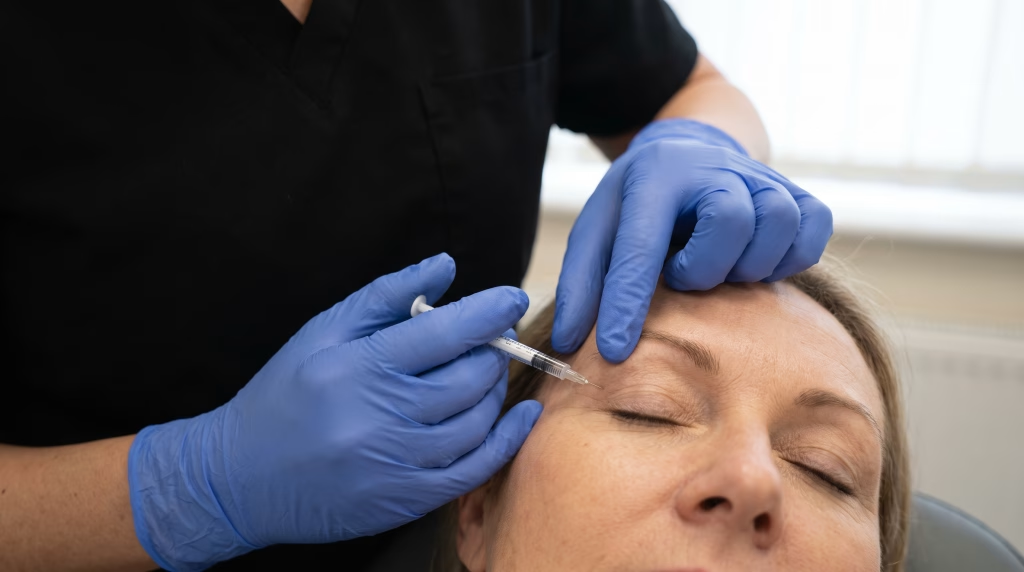
Anti-wrinkle injections relax the orbicularis oculi so the skin folds less when you smile or squint. For dynamic crow’s feet, the usual technique places points about 1.5 cm from the lateral canthus or 1 cm lateral to the bony orbital rim, with 6 to 18 units of onabotulinumtoxinA per side in 3 to 4 injections spaced 1 to 1.5 cm apart along a 90 to 180 degree arc (clinical technique review). That spacing matters because it softens the muscle while keeping the product away from the lid.
The evidence supports that approach. In controlled studies, onabotulinumtoxinA achieved a median 120-day return to baseline severity at the 24 U dose, with response lasting at least 4 months in key studies (study summary). In another placebo-controlled study, investigator responder rates were 54.9% to 59.0% versus 3.3% with placebo, and subject assessment was 45.8% to 48.5% versus 3.3% with placebo (trial data). A later study found 55% of patients on 24 U and 59% on 44 U reached none or mild severity at day 30, again compared with 3.3% on placebo, in the same trial data.
Practical rule: if the line is mainly there because the muscle pulls, relax the muscle first.
For skin maintenance, topical retinoids and other eye-safe skincare can improve texture over time, but they do not stop the movement that makes the crease form. The same applies to many home-care routines. They can support the surface, but they cannot replace a procedure once the line has become established.
For a fuller clinical explanation of injection-based care, see anti-wrinkle injections. If you want a consumer-facing skincare angle for the eye area, Buy Me Japan’s guide to Japanese under-eye patches and what they do is useful for comfort and surface hydration, not for structural wrinkle correction.
Where fillers, resurfacing, and skin boosters fit
Dermal fillers do not stop movement. They add support where the skin has already etched and volume has thinned. That can help some eye-area ageing patterns, but it will not suit everyone, especially where lid anatomy is already delicate.
Resurfacing, chemical peels, and microneedling target surface texture and skin quality. They make more sense when the main issue is crepey texture or fine etched lines, not strong expression folds. If the skin around the eyes is the main concern, injectable hydration or other skin-quality treatments can be layered in, but they should be chosen because the skin needs them, not because injections alone did not go far enough.
Choosing Treatment by Wrinkle Type and Eye Shape
The best choice depends on what you’re seeing in the mirror. Dynamic lines, static lines, lower-lid laxity, and upper-lid ptosis are different problems, so they don’t all point to the same treatment.
Match the line to the method
| Wrinkle type or anatomy | What it usually looks like | More suitable direction |
|---|---|---|
| Dynamic lines | Appear or deepen when smiling or squinting | Anti-wrinkle injections |
| Static etched lines | Stay visible at rest | Skin quality work, resurfacing, or layered treatment |
| Lower-lid laxity | Loose lower lid, heavier eye area | Cautious planning, sometimes support rather than more toxin |
| Upper-lid ptosis | Lid sits lower, eye looks heavier | Medical assessment first, sometimes a different route entirely |
That table is the reason a simple “just get injections” answer often falls short. A periocular assessment looks at where the lines sit, how the eyelid moves, and whether the skin has enough support to hold the result. In specialist reviews, this pre-treatment assessment is one of the clearest ways to improve outcomes, because it stops over-treating one feature while missing the underlying issue.
When more product is the wrong answer
If the lines are etched into the skin, adding more toxin can soften movement without fully flattening the crease. If the lid already droops, freezing the outer eye harder can make the area look heavier. And if the lower lid is loose, an aggressive plan can make the under-eye transition look less clean rather than better.
That’s where combination planning comes in. The right path might be injections plus skin support, or injections plus a resurfacing approach later on, rather than one treatment repeated on its own. For people who are already thinking about skin quality around the eye, skin hydration injections can be part of the conversation when the concern is texture and moisture support rather than muscle motion.
If the wrinkle stays when the face is still, don’t expect muscle relaxation alone to erase it.
The cleanest result usually comes from treating the dominant cause first, then deciding whether the eye area needs a second layer of care. That’s the difference between a quick fix and a proper plan.
Your Consultation and Booking at House of Glam HQ
At House of Glam HQ, the process starts with a real conversation, not a booking form that assumes everyone wants the same thing. The £25 prescriber consultation is legally required before first anti-wrinkle treatment, and the 14-day review is included. That protects you, and it protects the result.
What I check before treatment
I look at medical history, current medication, whether you’re pregnant or breastfeeding, and what your face does at rest and in motion. I also ask what outcome you want, because “less wrinkling” can mean very different things to different people. Some want a softer smile line, some want the outer eye softened only, and some realise after assessment that injections alone won’t solve the whole concern.
House of Glam HQ is run by me, Natasha, as a sole practitioner in Southsea, Portsmouth, with 7+ years clinical experience. That means you’re not passed around a team, and the plan is built by one clinician who knows the face, the product, and the follow-up. I also keep the diary one-to-one per date for training bookings, so the pace stays controlled and the care stays personal.
How to book
- Call: 07831 846273
- Email: houseofglamhq@gmail.com
- Read first: verified reviews across Google, Fresha and Facebook
And if you’re comparing clinics, use the consultation to ask direct questions about eye anatomy, not just price. If someone can’t explain the difference between dynamic lines and etched lines, they’re not treating the area properly. The right practitioner should be able to tell you why your plan is what it is, and why another option is being left out.
Treatment Timeline and Aftercare Steps
Many seek a simple answer here: when will results appear and how long will they last. For crow’s feet treatment, a visible effect usually starts within 3 to 10 days and lasts about 3 months, which is why maintenance is commonly planned around 3 to 4 monthly intervals (timing guidance). That’s the honest rhythm of the treatment, and it’s why “one and done” isn’t the right mindset.
A plain treatment timeline
- Injection day. The area is assessed, marked if needed, and treated with care around the eye.
- First few days. The muscle starts to relax and the outer eye softens gradually.
- Around day 3 to 10. The visible change usually becomes clear.
- Around month 3. The effect is typically at its most noticeable for many people.
- Month 3 to 4. Planning for the next appointment makes sense before the lines fully return.
Aftercare is simple, but it matters. Don’t rub the area, stay upright for a few hours after treatment, avoid intense exercise for 24 hours, and come back for the included 14-day review. If you want a clinical checklist style reminder, the anti-wrinkle injection recovery tips page is the right place to start.
The aftercare doesn’t need drama. It needs consistency.
If deeper etched lines are present, the result may improve but still look faintly lined at rest. That’s where a second treatment layer may come in later, often aimed at skin quality rather than more muscle relaxation. Results aren’t permanent, and that’s normal.

When Combination Therapy Beats a Single Treatment
Static crow’s feet often need more than muscle relaxation. If the lines are etched, the skin is crepey, or the eye area has lost support, a single treatment can leave the result looking unfinished. Combination care makes sense for many people, especially when the goal is a softer eye area without flattening the character of the outer face.
The clinical evidence supports that approach. A study report from 2023 reported long-term improvement in crow’s-feet wrinkles when botulinum toxin was combined with another modality. That matches what I see in practice. Relaxing the muscle addresses movement, but it does not rebuild skin quality on its own.
Who usually needs a layered plan
- People with etched lines at rest, because those lines are already sitting in the skin.
- People with crepey texture, because movement control will not change surface quality enough.
- People with lower-lid laxity or lid heaviness, because over-treating can make the area look less balanced.
- People who have had injections before but still see the line at rest, because the remaining wrinkle may be structural rather than muscular.
Skin support, resurfacing, and carefully chosen hydration work all have a role here. skin hydration injections can fit into a layered plan when the skin needs more moisture and bounce, and resurfacing can help where texture is the main issue. If the eye area is anatomically tricky, the safer route is usually a slower plan, not a stronger one.
Public content often makes it sound as if wrinkle relaxing injections are the whole answer. They are the most predictable first step for movement lines, but once the wrinkle is set in, the skin often needs another tool.
Crow’s Feet Treatment FAQ and Cost Ranges
How much does it cost? At House of Glam HQ, the £25 prescriber consultation is separate and legally required before first anti-wrinkle treatment, and treatment pricing is discussed after assessment because the right plan depends on your face, not a generic menu. How long does it last? Usually around a season, which is why repeat booking is planned rather than guessed.
Can men have it? Yes, anti-wrinkle injections and fillers are offered to both men and women. Can fillers cure crow’s feet? No, they improve appearance and can be reversible with hyaluronidase, but they’re not a cure and they don’t replace a proper eye-area assessment.
And if you’re still unsure, start with the anatomy question, not the product question. That one choice saves people the most regret.
If you want clear advice on whether anti-wrinkle injections, skin support, or a combination plan makes sense for your crow’s feet, book with House of Glam HQ. I’ll assess the eye area properly, talk you through the options thoroughly, and only recommend what fits your anatomy and goals.

