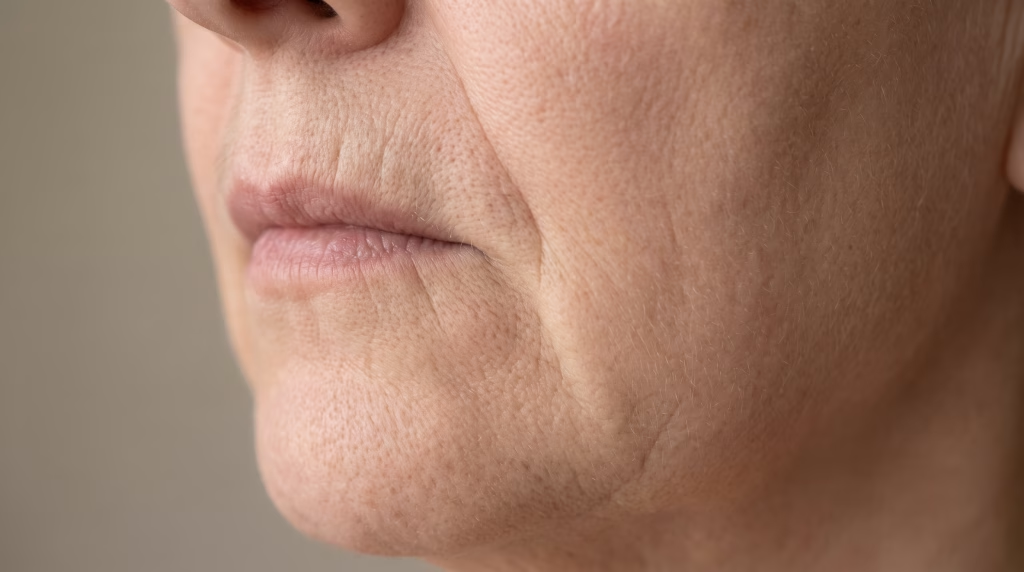
You’re probably here because you’ve noticed those lines at the corners of your mouth starting to pull everything down. Maybe they make you look tired, stern, or a bit sad even when you feel fine. I see this concern a lot in clinic.
The layperson term is usually lines at corner of mouth. Clinically, we’re usually talking about marionette lines, also called melomental folds. And if you’re thinking about filler, the honest answer is this: sometimes filler helps beautifully, and sometimes treating the line you’re pointing at is the wrong plan.
I’m Natasha, sole practitioner at House of Glam HQ in Southsea, Portsmouth, and I’ve been treating faces for 7+ years. I’m direct about this area because it’s easy to get wrong. The best result usually comes from understanding why the line is there first, then treating the face in a way that looks balanced, not puffy.
Understanding Those Lines at the Corners of Your Mouth
The lines at the corners of your mouth are usually marionette lines, also called melomental folds. In clinic, I see people focus on the crease itself, but the crease is often only part of the story.

Why they start to show
These lines usually develop because support in the lower face changes over time. Collagen declines. Skin gets less springy. Fat pads shift. The cheeks can flatten, the mouth corners can turn down, and the area beside the chin starts to look heavier. What you notice as a line is often a mix of shadow, volume loss, and descent.
That is why I do not treat this as a simple “fill the groove” problem.
Some people mainly have a soft crease. Others have a stronger downward pull at the mouth corners, a heavier jowl area, or a chin that is not giving enough support to the lower face. Those are different patterns, and they do not all respond well to filler placed directly into the line.
Practical rule: I assess the whole lower face first. If the cheek, jawline, or chin is driving the problem, and it often does once a jowl has started to form along the jaw, treating the corner alone usually gives a weaker result.
Skin quality plays a part too. If the tissue is thin, crepey, or dehydrated, adding filler into the fold can leave the area looking bulky without really improving the finish. In those cases, I may suggest skin boosters Southsea to improve hydration and texture, then reassess whether filler is even the right next step.
What filler can and can’t do
Filler can soften marionette lines and improve support in the lower face. It can also make this area look worse if it is used in the wrong place, in the wrong amount, or before the rest of the lower face has been assessed properly.
This is the trade-off. Treat the visible line only, and you may get a quick change that does not look especially natural. Treat the structure causing the line, and the result often sits better and lasts more gracefully.
I aim for a mouth that looks less downturned, less heavy, and more balanced at rest. Not a frozen lower face. Not an overfilled one. Just fresher, with your natural movement still there.
Is It a Wrinkle or Is It Soreness A Critical Distinction
Before anyone even thinks about filler, I want to separate one thing clearly. If the corner of your mouth is red, cracked, sore, inflamed, crusty, or split, that may not be a cosmetic line at all.
It may be angular cheilitis.

When it isn’t a filler problem
According to DermNet’s overview of angular cheilitis, angular cheilitis is primarily caused by saliva pooling in the oral commissures, creating a moist environment for Candida albicans or Staphylococcus bacterial overgrowth. Clinical findings typically include erythema, fissures, ooze, and crusting at one or both angles of the mouth.
That matters because filler will not fix that. And I won’t treat it as if it’s a cosmetic issue when it needs medical care.
If the skin is broken or inflamed, you need the cause dealt with properly first. In UK practice, that may mean treatment for fungal or bacterial overgrowth, plus sorting out contributing factors such as saliva trapping or denture fit.
Quick way to think about it
Here’s the distinction I use in clinic:
- A fold or downturn with intact skin usually points more towards a structural ageing concern.
- Cracking, burning, soreness, ooze, or crusting points towards a medical issue that should be assessed by a GP or pharmacist.
- A mixed picture happens too. Someone can have marionette lines and irritated corners. In that case, the inflammation gets dealt with first.
Painful mouth corners are not a filler appointment.
This is one of the biggest reasons a proper consultation matters. People often use the same words for two completely different problems.
Why I Look at Your Cheeks to Treat Your Mouth
A lot of people come in and point straight at the line. Fair enough, that’s the bit bothering you. But I don’t start there. I start by looking at the whole lower face, and often the midface too.
The support problem
Consider this: If the upper support of a structure weakens, the lower part starts to sag. The mouth area often shows the result, but it isn’t always where the cause began.
Loss of support higher up, especially through the cheeks and midface, can let the lower face drift downward. Then the mouth corners deepen, the jawline softens, and the line beside the mouth becomes more obvious. In that situation, filling the corner alone can be a poor fix. It can make the area heavier if done badly.
Sometimes I also assess the chin area because lower-face balance matters. A small amount of support around the chin or surrounding structure can sometimes improve the way the mouth sits at rest far better than putting all the product into the crease itself.
What I assess before deciding anything
I’m looking at several things at once, including:
- Cause of the line. Is this mainly a fold at the corner, or is volume loss above letting the area drop?
- Depth and shape. A shallow crease behaves differently from a fixed, deeper fold.
- Mouth posture at rest. Some people have a stronger downturned pull even before the fold itself is very deep.
- Facial balance. Treating one small area in isolation can throw the face off.
- Your goal. Some people want subtle softening. Others want a bigger visible change, and I’ll tell you whether that’s realistic.
If you’ve also noticed creasing around the smile line area, my Portsmouth nasolabial fold advice explains how nearby folds can connect and why the face needs assessing as a whole.
I won’t just inject the line you’re pointing at. I’ll tell you where filler is likely to help, where it won’t, and whether direct treatment, support from above, or a combination makes more sense.
My Approach to Treating Marionette Lines
A lot of people come in asking me to fill the line they can see at the corner of the mouth. Sometimes that is part of the answer. Often it is not the starting point.
My job is to improve the lower face without making the mouth look puffy, heavy, or odd in motion. With marionette lines, chasing the crease itself is how unnatural results happen.
Why I treat conservatively
The corners of the mouth are a high-movement area. You talk, smile, chew, and tense this part of the face all day, so any excess product shows up quickly.
I aim to soften the downturn and improve support. I do not try to wipe out every line. In clinic, the best result is usually a mouth that looks less tired and less pulled down at rest, while still looking like your face.
That can mean treating the marionette area directly. It can also mean using a small amount elsewhere first, then reassessing whether the corner still needs product. If cheek support has dropped or the chin is under-supporting the lower face, putting all the filler into the mouth corner can be the wrong move.
Sometimes less product gives the better result. It also avoids paying for filler you did not need.
What I use, and what I will not reduce to a template
If filler is suitable, I use CE-marked, medical-grade hyaluronic acid products. In this area, I prefer HA because it can be dissolved with hyaluronidase if needed, which adds a level of safety and flexibility in a very visible part of the face. Many of the products also contain lidocaine, which helps with comfort during treatment.
What I do not do is publish a generic injection map or a one-size-fits-all recipe. The right plane, product, and placement depend on tissue quality, movement, facial structure, and what is causing the downturn.
If assessment shows you are a good candidate, dermal filler treatment can support the corners of the mouth and soften marionette lines. I still treat that as a customized lower-face plan, not a standard syringe in a standard spot.
Painful, cracked, or inflamed mouth corners are a different issue and need medical treatment, not filler. If I suspect irritation, infection, or soreness rather than a true structural fold, I will tell you plainly and point you in the right direction.
That honesty gets better results. It also prevents the classic mistake of filling a problem that filler was never going to solve.
Your Treatment Timeline From Injection to Final Result
Filler behaves differently from anti-wrinkle injections. It adds volume straight away, so you’ll usually see improvement on the day. The area can look softer as soon as the filler is in.
But that first look is not the finished look.
What usually happens over the first days
Straight after treatment, there’s typically some swelling. Sometimes there’s bruising too. That’s normal for a treatment around the mouth, and it’s one reason I tell people not to panic on day one.
The rough pattern is simple:
- On the day you’ll usually see an instant change.
- Over the first few days swelling settles and any bruising starts to calm down.
- Around 7 to 10 days you can judge the settled result properly.
Don’t judge your filler in the first day or two. Wait for it to settle.
How long it typically lasts
Hyaluronic acid filler in this area generally lasts 6 to 18 months, depending on the area and your metabolism. It then breaks down gradually and naturally. Lips tend to sit at the shorter end because they’re more mobile, but marionette treatment is assessed as part of the lower face rather than using a fixed formula.
For practical recovery advice after your appointment, I send specific aftercare, and you can also read these dermal filler aftercare tips.
Your Next Steps at House of Glam HQ
Here’s the honest conclusion. Filler can work very well for lines at corner of mouth when the issue is mainly volume loss and structural support. But it isn’t the answer to every mouth-corner concern.
If the problem is more about skin texture, fine crepey change, or overall skin quality, I may suggest a different route. Sometimes that means skin-focused treatment rather than adding volume. And if the corners are sore or inflamed, I’ll tell you to get that treated medically before anything aesthetic is considered.
What a consultation with me is for
A proper consultation lets me work out:
| What I’m assessing | Why it matters |
|---|---|
| Cause of the downturn | Direct filler isn’t always the best starting point |
| Depth of the fold | Deeper fixed lines need realistic expectations |
| Skin quality | Some concerns respond better to skin treatments |
| Facial balance | The face needs to look natural as a whole |
| Your goal | Subtle softening and a bigger change aren’t the same plan |
At House of Glam HQ in Southsea, Portsmouth, every treatment is carried out by me personally. No staff, no hand-off. Just one-to-one assessment and treatment. A consultation is £15, and that comes off your treatment if you go ahead. Marionette lines or corner-of-mouth filler is £150 via my dermal fillers page. For context, if surrounding support is part of the plan, lip and chin filler starts from £130.
I’ve built my clinic around honest advice. If filler is right, I’ll say so. If it isn’t, I’ll say that too. That’s a better result in the long run than chasing the wrong treatment.
And if you’re also considering anti-wrinkle treatment elsewhere on the face, remember that in the UK a prescriber consultation is legally required before first treatment. Mine is £25, and the 14-day review is included. My own prices are on the anti-wrinkle injections page: £170 for one area, £210 for two and £250 for three. I mention it only because people often compare lower-face concerns with other injectable options, and they’re not the same type of treatment.
If you want an honest opinion on whether your lines at the corners of the mouth need direct filler, support from the cheek or chin, or a different treatment entirely, book a consultation with House of Glam HQ. You can also contact me directly at houseofglamhq@gmail.com or call 07831 846273. I’m based in Southsea, Portsmouth, and every appointment is with me personally.