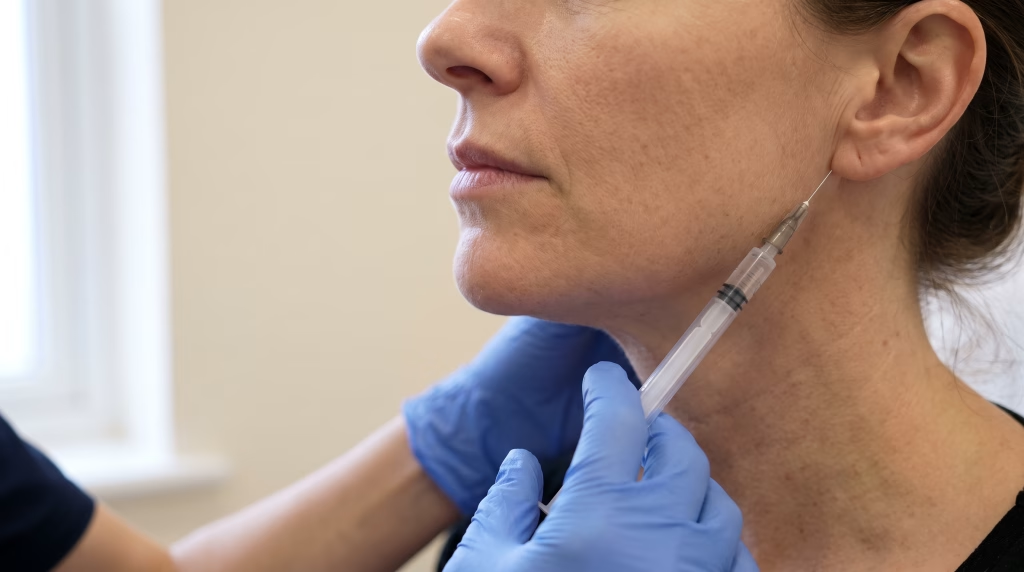
Nobody books filler because they want to know how long it lasts. They book because of a photograph, or a profile they have never liked, or a friend who came back looking rested. The longevity question turns up afterwards, usually at about eleven at night, and it is almost always really a money question: if this wears off, what am I signing up to?
So here is the honest version. Filler in the face typically lasts 9 to 18 months, and where you land in that range depends far more on which area you treat than on anything you do afterwards. Below is every area I treat, what it costs, how long I would expect it to hold, and what that works out at over a year. Every price is published, where most Portsmouth clinics quote only after a consultation.
How long do dermal fillers last?
Nine to eighteen months for most people, most areas. That is the figure I give at the consultation and it is the one I would plan your money around.
Hyaluronic acid filler is not permanent. Your body breaks it down slowly, a little at a time, which is why the change does not reverse overnight. It softens over months until the face you started with is the face you have again. Nothing is left behind.
You will read longer numbers than mine. Up to two years gets quoted a lot, and it is not wrong exactly, because a firm filler placed deep against bone in an area that barely moves genuinely can go that long. But I would rather quote you twelve months and have you pleasantly surprised at sixteen than quote you two years and have you feel short-changed at fourteen.
How long filler lasts, area by area
This is the table I wish more clinics published, because it is the one that actually answers the question. The last column is simply the price divided across the time it holds, so you can see what each area costs you per year rather than per appointment.
| Area | Price | How long it lasts | Roughly a year |
|---|---|---|---|
| Lip filler, 0.5ml Classic | £130 | 6 to 12 months | £130 to £260 |
| Chin filler, 0.5ml | £130 | 9 to 18 months | £87 to £173 |
| Chin filler, 1ml | £150 | 9 to 18 months | £100 to £200 |
| Nasolabial folds | £150 | 9 to 12 months | £150 to £200 |
| Marionette lines | £150 | 9 to 12 months | £150 to £200 |
| Cheek filler | £160 | 12 to 18 months | £107 to £160 |
| Jawline filler | £160 | 12 to 18 months | £107 to £160 |
| Pre-jowls and chin together | £190 | 12 to 18 months | £127 to £190 |
| Non-surgical nose job | £180 | 9 to 12 months | £180 to £240 |
Read the first and last columns together and the ranking changes completely. Lip filler has the joint-lowest headline price on the list and the highest annual cost, because lips wear off soonest. Cheek filler looks dearer at £160 and can cost you a third less per year. If your budget is the thing deciding what you book, that is worth knowing before you book the cheapest line rather than the one that holds.

Why the same filler lasts longer in a cheek than in a lip
It is movement, not product. The same syringe of hyaluronic acid placed in two different parts of the face will disappear at two different speeds, and the difference is how much that part of the face moves.
Your mouth never stops. You talk, eat, drink and smile with it all day, and every one of those movements works the gel a little. Filler in the lips is also placed shallow, in thin, well-supplied tissue. Both of those shorten its life, which is why six to twelve months is a realistic expectation there and why I never promise longer.
The mid-face and the jaw are the opposite. Filler there is placed deep, often right down against bone, in tissue that barely shifts. A firmer product in a still area breaks down more slowly, so twelve to eighteen months is normal for cheeks and jawlines. Nasolabial folds and marionette lines sit in between, at nine to twelve, because they are on the move but not as much as a lip.
Your own metabolism matters too, and I cannot predict it by looking at you. Some people run through filler quickly and always have. If that is you, you will find out after the first treatment, not before, and it is not something anyone can charge you to fix.

What happens to your face if you stop having filler?
It goes back to how it would have looked anyway. That is the whole answer, and it is worth saying plainly because the internet is full of people insisting otherwise.
Hyaluronic acid is a substance your body already makes and already knows how to break down. When you stop, the gel clears and the area returns to its own volume. You do not end up worse off than when you started, and nothing collapses.
What does happen is that you have aged in the meantime. If you had cheek filler at 38 and stop at 44, the face you get back is a 44-year-old face, not the 38-year-old one you remember. That can feel like a sudden drop, and people describe it as the filler having “ruined” something when what has actually happened is six years passing while the filler quietly covered for it. It is a real experience and it is not the filler’s doing.
There is one genuine caveat. Very large volumes placed repeatedly over many years can stretch tissue, and that is a different situation from the amounts on the table above. It is the main reason I am careful about how much I place and why I would rather see you back for a small top-up than put a lot in at once.
Can fillers make you look ten years younger?
No, and I would be wary of anyone who says they can.
Filler adds volume. Where volume is genuinely what you have lost, replacing some of it can make you look rested and a bit less tired, and that reads as younger to other people without anyone being able to say why. That is the result worth having.
What filler cannot do is tighten skin, remove a line that is etched in at rest, change your bone, or take a decade off a face that has lost firmness rather than volume. Chasing ten years with filler is how people end up overfilled, because when the first millilitre does not deliver it the temptation is to add another.
Which lasts longer, anti-wrinkle injections or fillers?
Filler lasts considerably longer. Anti-wrinkle injections typically last three to six months, with most clients coming back every three to four months at first, against nine to eighteen for filler.
They are not alternatives, though, and picking by duration alone gets people the wrong treatment. Filler replaces volume that has gone. Anti-wrinkle injections relax the muscle that is creasing the skin. A hollow cheek will not respond to a muscle relaxant, and a line across the forehead will not be fixed by adding volume underneath it. If you are not sure which of the two your face actually needs, the comparison is written out here.
If anti-wrinkle injections are what you end up booking, a prescriber consultation is required by law before a first treatment. That is £25 and is paid once per prescription period, and a review at 14 days is included in the price.
When to top up, and why coming in early uses less
Filler does not vanish on a date. It softens, and most people notice the change rather than the absence: the profile they had got used to starts to look like the old one, or the jaw edge blurs.
That moment is the one to come in on. Topping up while some of the original is still there almost always needs less product than starting from nothing, because you are adding to a base rather than rebuilding it. Leave it until everything has gone and you are paying for the first treatment again.
I do not run a recall list and I will not text you to say you are due. A top-up is a decision you make when you notice, and if you decide you liked your face better without it, that is a perfectly good outcome too.

What if you do not want to wait for it to wear off?
Everything I use is CE-marked hyaluronic acid, either Juvederm, Restylane or Belotero, blended with lidocaine so it keeps numbing as I work. Hyaluronic acid can be dissolved with hyaluronidase, so nothing here locks you in for a year and a half if you change your mind.
A dissolve patch test and consultation is £15 and is booked at least a week beforehand. Lip filler dissolving is £180, facial areas are from £180 depending on the area and confirmed at the patch test, and dissolving lips and refilling them as one treatment is £280. I will dissolve filler placed elsewhere as well as my own.
What filler will not do, whatever it costs
It will not move bone. It cannot change a bite, a jaw position or the length of a chin, and if an orthodontic problem is what is actually bothering you then filler is the wrong tool.
It will not tighten loose skin. Where the real change is laxity rather than lost volume, adding filler makes a heavy face heavier, and that is one of the most common reasons I say no to a treatment somebody has come in asking for.
It will not last the same length of time in you as it did in your friend. And it will not look like the photograph on your phone if the face in the photograph has different bone structure from yours, which is the conversation I would rather have at the consultation than afterwards.
Book dermal filler in Southsea, Portsmouth
I am Natasha, and I carry out every treatment at House of Glam HQ myself, at 1A Auckland Road East, Southsea. The consultation is £15 on Fresha and comes off the treatment when you go ahead, or it happens at the start of a treatment booked directly with no separate fee. I will tell you which areas, how many millilitres and the exact price before anything starts, and if I think one area will do what you want, I will say so.
Filler settles over about two weeks, and that settled shape is the one you keep. Treating more than one area in a visit is priced by the millilitre, from £250 for 2ml up to £525 for a full-face plan of up to 5ml. Klarna spreads any treatment over three monthly payments.
See every dermal filler price in Portsmouth, book on Fresha, or message me on WhatsApp or 07831 846273 if you would rather ask first.

