A first-time client once gripped the chair before I’d even opened the filler. Ten minutes later, she was asking whether the strange fullness in her lips was normal. After more than seven years injecting lips, I’ve learned that the fear usually comes from not knowing which sensations belong to the needle, which come from swelling, and which need urgent attention.
What the Appointment Actually Feels Like
I’ll use a typical first appointment to make this concrete. At minute 0, you’re seated for the consultation. I’m looking at your lips at rest and while you talk, checking balance, movement, skin condition, previous filler, medical history and what you want changed. There’s no injection sensation yet, but nervous clients often notice a dry mouth, tense shoulders or faster breathing.
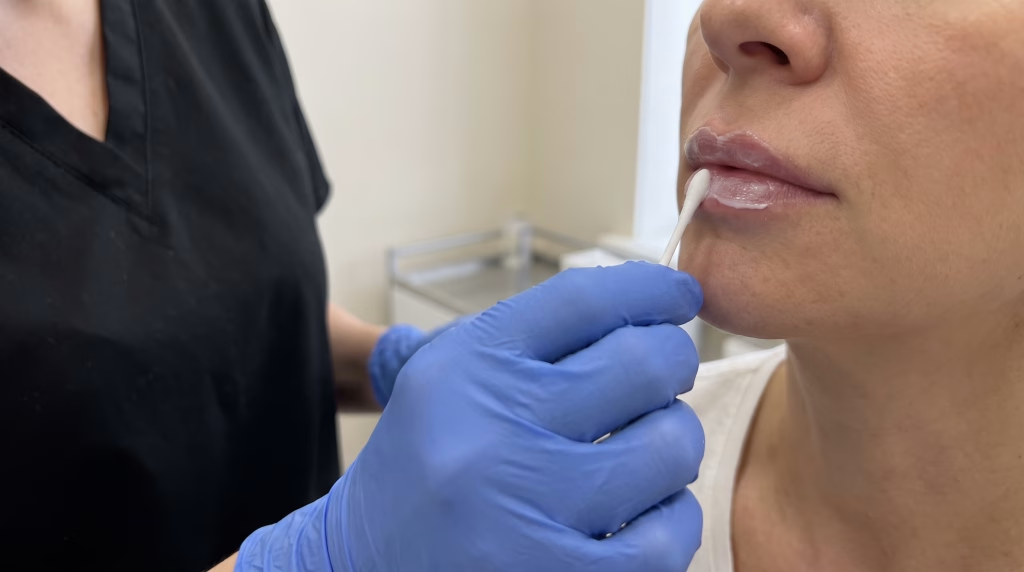
At around minute 5, I clean the area with an antiseptic wipe. It feels cool, slightly wet and clinical. The first application of numbing cream can feel cold, followed by tingling and a heavy, slightly strange feeling across the lips as the surface becomes less responsive. Lip filler usually isn’t painless, even where the product contains lidocaine. The ACE UK patient leaflet on lip fillers explains that lidocaine reduces pain but doesn’t remove sensation altogether, and that experience varies with technique, needle or cannula use and personal pain tolerance.
By minute 10 to 15, I’m marking the points and checking the plan with you. Conversation and breathing matter here. If you hold your breath before every entry, the pinch feels more dramatic. Slow breathing, a relaxed jaw and telling me when you need a pause give me useful control over the pace.

The injection phase
At minute 16, the first needle entry feels like a brief pinprick or sharp pinch. As the product moves in, the sensation changes to pressure, stretching and a short sting. Some clients describe a scratchy feeling, while others notice a brief burning sensation. The cupid’s bow and mouth corners can feel sharper because the tissue is particularly sensitive there.
Between minutes 17 and 22, the sensation comes in short bursts. A pass may feel like pressure, then a sting, then nothing. A cool gauze pressed against the lips is soothing and also removes small traces of blood or product. The final two minutes often feel longer than the first ten because you’re waiting for the last side to finish.
At minute 23 to 25, I hand you the mirror. Your lips can feel full, firm, numb or slightly throbbing. That fullness is partly the product and partly early swelling, so the mirror doesn’t show the finished result. If you’re still deciding between a subtle enhancement and more visible volume, read my guide to finding the right lip filler volume.
Knowing each phase usually makes the appointment feel shorter. You’re not waiting for an unknown event. You’re recognising a sequence of coolness, tingling, pinching, pressure, gauze and fullness.
Why Lips Feel More Than Other Filler Areas
Lips are among the most pain-sensitive facial sites because they have dense sensory innervation. That’s why a lip injection can feel more noticeable than filler placed in the cheek, chin, nasolabial fold or jawline. The ACE UK lip filler guidance also confirms that lidocaine in many hyaluronic acid filler syringes reduces discomfort without making the treatment pain-free.
The lip has thin tissue, a highly mobile muscle, and a concentrated network of sensory structures around the vermilion border and mouth. There’s less soft tissue padding between the injection and the structures that register pressure, stretch and temperature. A needle moving through that area can therefore produce a clear pinch even when a surface anaesthetic has worked well.
Cheek and jawline filler is often placed deeper, where there’s more tissue between the skin and the intended product plane. That doesn’t make those treatments sensation-free, but the mechanical experience differs. With the lips, the injector is working in a small, mobile area where even a modest amount of product can create a noticeable feeling of internal pressure.
What the filler adds
Hyaluronic acid filler attracts water. Once placed, it contributes to a sense of fullness and stretch inside the lip as well as causing the ordinary local response to a needle pass. That delayed tightness is why some clients say the appointment itself was manageable, then notice more tenderness later.
Most of the products I use are lidocaine-blended, CE-marked hyaluronic acid fillers. The lidocaine begins reducing sensation as the product is placed, but it doesn’t cancel the first entry or every deeper pressure sensation.

The practical takeaway is simple: lip filler sensitivity is structural, not a sign that you’re being dramatic or failing to cope. Comfort planning deserves its own discussion because the lips respond differently from other injection sites.
How Technique Changes the Sensation
Technique changes what you feel, how often you feel it and where the pressure sits. At House of Glam HQ, my lip options are Classic, Signature and Russian, and the choice should follow your anatomy and desired shape, not a trend or a promise of a particular celebrity look.
Classic normally uses fewer entry points and places product deeper into the lip body for volume. Signature sits between definition and fullness, while Russian works more superficially to build vertical definition and emphasise the lip shape. The exact number of passes and amount of product depend on your anatomy and treatment plan, so the figures below are useful planning ranges, not guarantees.
Technique Comparison: Sensation and Approach
| Technique | Typical Sensation | General Approach | Product Depth |
|---|---|---|---|
| Classic | Often the least intense, with brief pinches and pressure | Usually fewer planned entry points, with more focus on body volume | Deeper body volume |
| Signature | Moderate, often more pressure than sharpness | A balance of definition and fullness, adjusted to shape and volume goals | Mid-depth threads and definition |
| Russian | Sharper and more frequent because of superficial passes | More detailed shaping around the border and philtral columns | More superficial definition |
Russian technique can feel sharper because, in my hands, it usually involves more superficial work. The upside is detailed border and vertical definition. The trade-off is that the appointment can feel busier, with more separate pinches rather than fewer, deeper pressure sensations.
Classic tends to feel more straightforward. In my hands, it usually involves fewer entry points than Russian, although deeper placement can produce a stronger pressure sensation at individual points. Signature is often a middle ground, but “middle” doesn’t mean identical for every client.
Product viscosity matters too. A structured filler may give more resistance during placement, while a softer product can feel smoother. I use CE-marked hyaluronic acid products from reputable pharmaceutical suppliers, including Juvederm, Restylane and Belotero, all blended with lidocaine and reversible with hyaluronidase.
The same principle applies outside the lips. Someone comfortable with jawline filler shouldn’t assume lip filler will feel identical, because the anatomy and injection depth differ.
Pain-Reduction Options You Can Ask For
Pain reduction works best when it changes the signals reaching your nerves. Some measures have a clear physical purpose. Others look reassuring but make less difference than calm pacing, accurate placement and a product that already contains lidocaine.
A topical anaesthetic cream can reduce surface sensation. A lidocaine-prilocaine cream is commonly applied 20 to 30 minutes before injection, although the exact timing depends on the product and clinical plan. It doesn’t fully numb deeper tissue, so you may still feel pressure, stretching and the product entering the lip.
Options that can change the experience
-
Topical numbing: Dulls the surface and takes the edge off needle entry, but won’t remove every deeper sensation.
-
Cold compress: Cooling the vermilion border before a pass can blunt sensation, while cool gauze afterwards helps soothe the area.
-
Vibration: A small buzzing device can distract nearby sensory signals. It’s useful for needle anxiety, though it doesn’t replace good technique.
-
Cannula placement: A cannula may reduce the number of entry points, but it doesn’t automatically mean less discomfort. The entry point can still be felt, and a cannula isn’t suitable for every placement.
-
Lidocaine-blended filler: Lidocaine works from within as the product is deposited. The trade-off is that it can slightly alter the filler’s viscosity during placement, which affects how the product handles.
-
Additional local anaesthetic: A tiny pre-numbing injection can be discussed where clinically appropriate. It adds another needle sensation before treatment, so it isn’t automatically the better option.
-
Oral pain relief: Paracetamol may be acceptable before an appointment if it’s suitable for you. Ibuprofen and aspirin can increase bruising risk, so don’t take them for this purpose without discussing your medication and medical history with a clinician.
I don’t offer nitrous oxide or Entonox as a standard House of Glam HQ treatment. If a client asks about it, they should check whether a medically appropriate provider offers it and whether it’s suitable for their health.
The measures that usually make the biggest practical difference are enough time for topical anaesthetic, a steady injection pace, clear communication, cooling and a product containing lidocaine. The ingredients in medical-grade lip fillers also matter because product composition affects handling as well as comfort.
The First 24 Hours to Two Weeks After Treatment
The injection sensation ends quickly, but the healing phase carries on after you leave. At hour 0 to 6, the numbing effect fades and you may notice tenderness, mild throbbing, tightness or firmness. Your lips can look larger than expected because swelling has started, and the two sides may not appear identical.
In my experience, tenderness usually peaks during the first 24 to 48 hours, and most swelling and soreness settles within 3 to 7 days. Mild residual sensitivity can last for up to two weeks as the filler settles.
A realistic settling timeline
-
First evening: Use a cool compress intermittently, sleep with your head propped up and handle the area gently. Don’t massage the lips unless I’ve specifically instructed you to.
-
Day 1: Swelling can be most obvious and may be asymmetrical. That alone doesn’t mean the filler has migrated. Avoid alcohol, heat and strenuous exercise for 24 to 48 hours, and avoid makeup on the injection area for 12 hours.
-
Days 2 to 3: Tenderness should begin easing. Bruising may become more visible and can change from red-purple towards green-yellow as it resolves.
-
Days 4 to 7: Swelling usually reduces and the filler starts integrating with the surrounding tissue. Mild firmness can still be present.
-
Around day 14: The lips are a more reliable reflection of the settled shape. This is why I judge the settled shape at around two weeks rather than in the first few days.
The most common mistake is judging the result too early. Swelling can exaggerate size, hide the border and make one side look different while the tissue is reacting. My dermal fillers aftercare tips give you a practical reminder of what to do and what to avoid.
Normal Soreness Versus a Warning Sign
Normal soreness is usually diffuse, tender to touch and present across both lips. It should gradually ease after its early peak. A cold compress and suitable paracetamol may help, provided paracetamol is safe for you and you follow the product instructions.
Warning pain behaves differently. It can be severe, escalating or disproportionate to the treatment, and may come with pallor, blanching, dusky or purple colour, mottling, unusual vessel patterning, blistering or changes in vision. Redness with pus or fever also needs prompt clinical attention.
BBC reporting on figures from the British College of Aesthetic Medicine said dermal filler complications were recorded at 3 per 1,000 treatments, compared with 1.5 per 1,000 in 2021, in the context of increased adverse-event reporting. That figure doesn’t predict your individual outcome, but it explains why every injector should give clear emergency advice rather than dismissing severe pain as ordinary swelling.
Normal Soreness vs Warning Signs After Lip Filler
| Feature | Normal Soreness | Warning Sign |
|---|---|---|
| Pain pattern | Tenderness that settles and is usually spread across the treated area | Severe, burning or worsening pain, especially if disproportionate |
| Colour | Mild redness near injection points | White, pale, dusky, purple or mottled skin |
| Swelling | Expected early swelling that gradually eases | Rapid or worsening swelling with other concerning symptoms |
| Skin changes | Possible bruising | Blistering or a visible irregular vessel pattern |
| Other symptoms | Firmness, sensitivity or mild throbbing | Pus, fever or vision changes |
Vascular compromise can present quickly, so contact the clinic immediately, send clear photographs and don’t wait to see whether it settles overnight. Hyaluronidase may be needed promptly when hyaluronic acid filler is involved. Delayed reactions also exist. A review of hyaluronic acid filler complications found that local reactions such as swelling, firmness, redness, itching, pain or tenderness can appear from days after treatment through to much later, so a delayed concern still deserves assessment. Persistent lumps and nodules are covered in my guide to lip filler lumps and nodules.
Who Lip Fillers Suit and How to Book
Lip filler suits adults who want a measured change, understand that swelling is temporary and can describe what they want in terms of shape, balance or volume. I’m looking for healthy skin, realistic expectations and willingness to follow aftercare. I also need to know about cold sores, dental problems, medication, allergies, previous filler and any relevant medical condition.
Treatment should wait if there’s an active herpes outbreak, recent dental infection, pregnancy or breastfeeding. Isotretinoin use in the last six months and an autoimmune flare are definite reasons for a proper medical discussion before proceeding. Very thin lips may need a staged build-up rather than a large first appointment. Smokers may find crisp definition harder to maintain, and anyone seeking a single-visit celebrity shape is unlikely to be a good candidate for my approach.
What I assess before injecting
I assess the lips at rest and during movement, then discuss shape versus volume. We’ll talk through Classic, Signature and Russian, the likely sensation of each, whether a needle or cannula is appropriate and what level of swelling could interfere with your plans. You can also ask about the syringe, the product and the comfort measures available.
House of Glam HQ offers 0.5ml Classic at £130, Signature at £140 and Russian at £150. One-millilitre options are Classic £150, Signature £160 and Russian £180. Every lip filler price is published, and Klarna is available on treatments over three monthly payments. The clinic uses CE-marked hyaluronic acid only, from Juvederm, Restylane and Belotero, with lidocaine blended into the filler and hyaluronidase available for reversal where clinically required.
You can book a standalone consultation on Fresha with a £15 deposit, deducted from treatment if you go ahead. Alternatively, book the treatment directly and the consultation happens at the start of the appointment with no separate consultation fee. Appointments are booked in advance. Past clients can book directly, and cancellation terms apply to protect the reserved appointment time.
The clinic is at 1A Auckland Road East, Southsea, Portsmouth, PO5 2HA. I’m Natasha, the sole practitioner at House of Glam HQ, and I provide the consultation and the injection myself. If you’re unsure whether lip filler is suitable, a consultation is the right place to pause and ask rather than committing to a technique before your lips have been assessed.
Frequently asked questions
Do lip fillers hurt?
You’ll usually feel a pinprick, scratching, stinging or brief burning during entry and product placement. Lidocaine-blended filler and topical anaesthetic reduce discomfort, but lip filler isn’t completely pain-free.
Which lip filler technique hurts least?
Classic often feels less intense because it uses fewer entry points, while Russian can feel sharper because it involves more superficial passes. Signature commonly produces more pressure than sharpness. Your anatomy and technique plan still matter more than a label.
How long does lip filler soreness last?
Tenderness usually peaks during the first 24 to 48 hours. Most swelling and soreness settles within 3 to 7 days, although mild sensitivity can continue for up to two weeks.
Is swelling on one side normal?
Early asymmetrical swelling can happen and doesn’t automatically mean migration. The shape should be judged after the initial swelling has reduced, usually at around two weeks.
What pain after lip filler needs urgent help?
Severe or worsening pain, especially with pale, white, dusky or purple skin, mottling, blistering or vision changes, needs immediate clinical review. Contact the clinic rather than waiting to see whether it settles.
Who should delay lip filler?
Treatment should wait with an active cold sore, recent dental infection, pregnancy, breastfeeding or an autoimmune flare. Isotretinoin use in the last six months also needs careful assessment before treatment.
How much do lip fillers cost at House of Glam HQ?
House of Glam HQ prices 0.5ml Classic at £130, Signature at £140 and Russian at £150. One-millilitre Classic is £150, Signature £160 and Russian £180. Klarna is available through three monthly payments.
Book a consultation
If you are considering lip filler in Portsmouth, the right first step is a consultation. Book a standalone consultation on Fresha for a £15 deposit, deducted from your treatment if you go ahead, or book your treatment directly and your consultation happens at the start of the appointment with no separate fee. Klarna finance is available on treatments.
-
Book on Fresha: Book your consultation or treatment
-
WhatsApp: Message Natasha on WhatsApp
-
Call: 07831 846273
-
Email: houseofglamhq@gmail.com
House of Glam HQ offers Classic, Signature and Russian lip filler in Southsea, Portsmouth, with lidocaine-blended hyaluronic acid, clear aftercare and honest advice. If you want an honest assessment of what will suit your lips and pain tolerance, visit House of Glam HQ and book with Natasha.

