The most popular advice about polynucleotide skin boosters in Portsmouth is to treat them as the latest answer to every skin concern. I do not agree. They are a promising injectable option for skin quality, but the evidence is still developing, treatment plans take patience and the result may be modest. The better question is not, “Are polynucleotides better than everything else?” It is, “Does this treatment match the skin problem I want to address?”
I am Natasha, sole practitioner at House of Glam HQ in Southsea, Portsmouth, with more than seven years of clinical experience. I assess the skin, medical history, expectations and budget before recommending an injectable. If another treatment, or no treatment, makes more sense, I will say so.
What Polynucleotide Skin Boosters Actually Are
Polynucleotides are not another name for Profhilo. They are purified DNA fragments, commonly associated with salmon-derived material, introduced into the skin through intradermal injections. UK aesthetic literature generally describes them as a form of short-to-medium-term biorevitalisation, intended to support the local skin environment rather than create permanent structural change.
A 2025 review covering nine studies and 219 patients found statistically significant improvements in wrinkles, texture and elasticity, but that result needs context. The review suggests an encouraging signal, not proof that every product, injection technique or treatment course will produce the same outcome. The evidence base remains small, and published follow-up is limited.
A useful way to think about them is this: a polynucleotide treatment aims to support the skin’s repair environment, while a filler places structure or volume into an area.
That distinction matters. Hyaluronic acid dermal fillers are designed to restore or add physical volume. Polynucleotides are generally used when the concern is hydration, elasticity, firmness, texture, fine crepiness or skin that looks finely crinkled, rather than a hollow that needs structural support.
Topical skincare can support the surface and may improve how skin feels and looks, but injected treatment places the product in a different environment. That does not make an injectable automatically better. It means the route of delivery and intended action are different.
You can also read about my approach to skin booster treatment before deciding whether a consultation is appropriate.
How Polynucleotides Work Within the Skin
The simplest way to understand the proposed mechanism is to start with fibroblasts. These are skin cells involved in producing parts of the extracellular matrix, including collagen and elastin. Collagen contributes support, while elastin helps skin return towards its previous shape after movement.
Clinical literature links polynucleotide injectables with activation of the adenosine A2A receptor. That pathway is associated with fibroblast proliferation, collagen synthesis, anti-inflammatory signalling and angiogenesis. Those are biological processes connected with repair and tissue support, not instant filling of a crease.
The sequence is broadly described like this:
- Purified polynucleotide material is introduced into the skin.
- Local receptor activity is stimulated.
- Fibroblast activity and the surrounding tissue response are supported.
- Collagen and elastin production may increase as the skin responds.
A Journal of Aesthetic Nursing review also describes high-purity polynucleotides as reducing local free radicals, attracting water molecules around the injection site, supporting collagen and elastin synthesis and improving the viability of targeted fibroblasts. I would describe this as local support, not as the treatment flooding the whole body with water.
The aim is to encourage the skin to respond. It is not to force a fold open with added volume.
These pathways explain why the treatment is discussed for crepey or tired-looking skin, but they do not establish a guaranteed result. Products vary, protocols vary and individual skin responds differently.
For patients comparing procedures, skin pen microneedling works through controlled micro-injury and topical product delivery rather than the same injectable route. The right choice depends on the depth, location and type of concern.
What the Evidence Shows for Portsmouth Patients
The most reasonable clinical signs to discuss are hydration, elasticity, firmness, texture and fine crepiness. These are skin-quality outcomes. They are different from a sharper jawline, a lifted contour or a filled tear trough, which may require another approach.
A 2025 British Journal of Dermatology abstract reported sustained results up to six months, minimal adverse effects and improved firmness of 18% to 22% for polynucleotide-based therapies such as Nucleofill and Juvelook. That figure is specific to that abstract and should not be presented as a guaranteed outcome for every patient. An abstract also gives less detail than a full clinical trial report, so I would treat it as supporting evidence rather than a final answer.

What the evidence can tell you is that some patients see visible improvements in skin quality. What it cannot tell you is exactly how your skin will respond, how long your result will last, or whether one clinic’s product and technique are directly comparable with another’s. UK literature also points to a gap between enthusiastic consumer marketing and the strength of the available evidence. The treatment may help, but advertising language often moves faster than the data.
Before relying on photographs, ask what product was used, how many sessions were completed, whether the images were taken under the same lighting and how long after treatment the photograph was taken. My skin boosters honest review gives further context for assessing claims without treating every before-and-after image as proof.
Polynucleotides Compared with Other Skin Boosters
Treatment choice should follow the concern, not the popularity of the product name. Hyaluronic acid skin boosters primarily attract and retain water within the treated area. Profhilo is a stabilised hybrid cooperative complex of high- and low-molecular-weight hyaluronic acid, placed across planned treatment points. Polynucleotides are intended to stimulate the local skin environment through a different biological route.
That does not create a universal winner. Someone mainly concerned with dehydrated-feeling skin may discuss an HA-based option. Someone concerned with fine crepiness and texture may ask whether a polynucleotide course is suitable. Someone wanting physical contour or replacement of lost volume is discussing dermal filler, not a standard skin booster.
Dermal fillers also have a different expected lifespan. HA fillers typically last 6 to 18 months depending on the area, while lip filler typically lasts 6 to 12 months because the lips are more mobile. HA filler can be reversed with hyaluronidase, although reversal still requires clinical assessment and treatment.
A skincare injectable Profhilo discussion can help if hydration and overall skin quality are your priority. I would still assess the skin in person rather than selecting a product from a menu.
Product Choice and Pricing at House of Glam HQ
At House of Glam HQ in Southsea, Portsmouth, polynucleotide treatment is available using Dermis Glow Eyes, Dermis Glow Face, Vitaran Eyes, Vitaran, Lumi Eyes and Lumi Pro.
Current prices published by the clinic are:
- Dermis Glow Eyes: £135 per session
- Vitaran Eyes: £150 per session
- Lumi Eyes: £150 per session
- Dermis Glow Face: £155 per session
- Lumi Pro: £155 per session
- Vitaran: £185 per session
These are per-session prices. A course of 3 to 6 sessions, spaced around 3 to 4 weeks apart, may be recommended depending on the treatment area, skin condition and response.
For patients comparing options, the main distinction is usually treatment area and product choice. Vitaran Eyes and Lumi Eyes are positioned for the under-eye area, while Lumi Pro and Vitaran are used for broader facial skin rejuvenation.
You can see the full menu and book directly on my polynucleotide treatments in Portsmouth page.
I’ll confirm the right product for your skin, the recommended number of sessions and the full course cost at your consultation, before you commit to anything.
For context, UK media coverage such as Harper’s Bazaar UK quotes £250 to £700 per session nationally, noticeably above House of Glam HQ’s published prices.
Treatment Process, Timeline and Aftercare
I start with consultation, not a syringe. I assess your skin condition, treatment goal, medical history, medicines, allergies and previous aesthetic procedures. I also consider whether the concern is better addressed with an injectable, microneedling, a peel, a facial or no treatment at all.
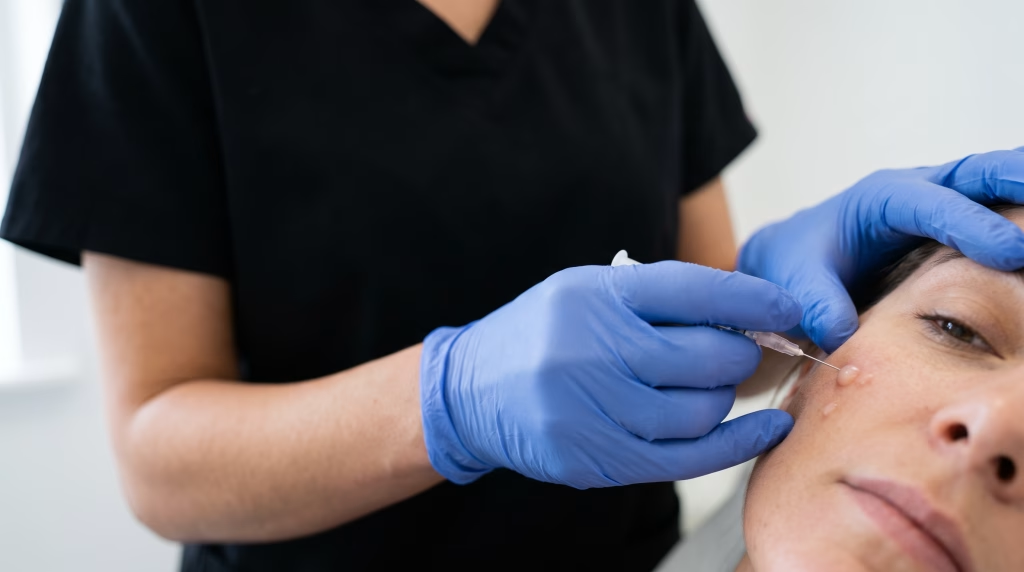
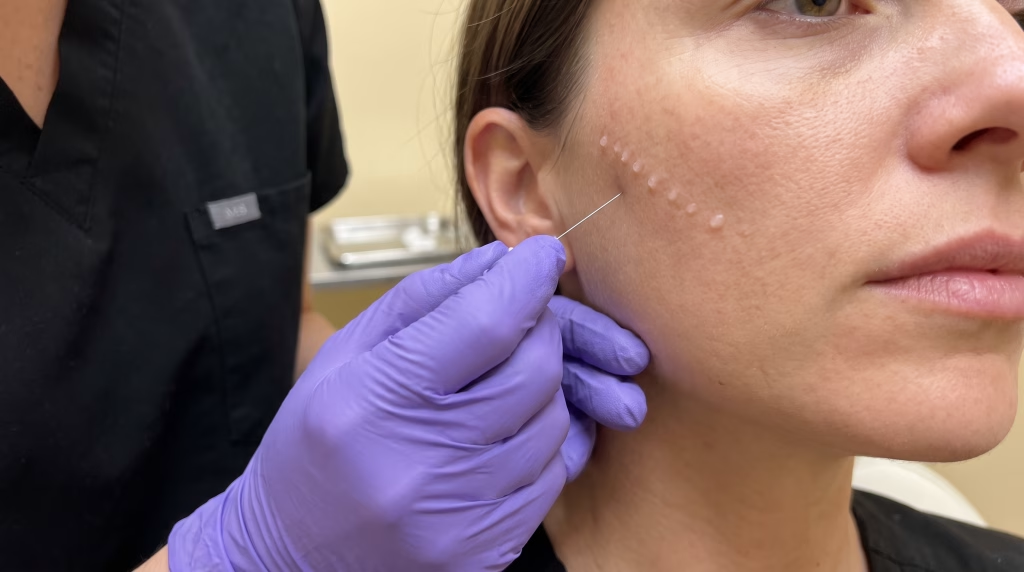
On treatment day, the skin is cleansed and the injection points are planned. Polynucleotides are delivered intradermally, so small raised areas, redness, swelling or pinpoint marks can appear straight afterwards. These visible changes are connected with the injection process and do not mean the final result has appeared.
A course of three to six sessions, spaced around three to four weeks apart, is typical, but I confirm your schedule after assessment. Results generally develop over weeks rather than appearing as one dramatic instant change. Maintenance may be discussed later, depending on your response and the condition of the skin.

Aftercare should be simple and specific. Follow the written instructions I provide, avoid touching the area unnecessarily and contact me if anything feels unusual or worsens. Do not assume a more intense reaction means a better outcome.
The same principle applies across injectable treatments. My dermal filler aftercare guide explains why clear aftercare and sensible follow-up matter, even though the product and procedure differ.
Safety, Suitability and Realistic Expectations
Most short-term reactions discussed in UK guidance are mild, including redness, swelling, bruising and small temporary bumps. That does not remove the need for careful practice. Product traceability, appropriate storage, informed consent, medical history and accurate treatment records all matter.
I would ask about fish allergy, pregnancy, breastfeeding and certain autoimmune or circulatory conditions before considering treatment. These points are not a complete universal contraindication list, and they do not replace an individual clinical assessment. They are reasons to disclose your history fully and wait for professional advice.
The UK regulatory position needs careful wording. A 2025 UK-facing review described injectable polynucleotides as Class III medical devices under the UK Medical Device Regulations 2002. Another literature review described a critical gap in the framework around polynucleotides, which is why it is sensible to ask how a clinic sources, prescribes, stores and documents any injectable treatment rather than assuming all providers work to the same standard.
The government’s planned licensing framework for non-surgical cosmetic procedures is being developed under powers from the Health and Care Act 2022. Its consultation response received more than 11,800 replies and confirmed a three-tier model for England, with rules expected to tighten around who can provide medium- and high-risk aesthetic treatments.
If the evidence, budget or health profile does not support treatment, I would rather recommend another approach or none.
Frequently Asked Questions About Polynucleotide Skin Boosters
Are polynucleotide skin boosters the same as Profhilo?
No. Both sit within injectable skin treatments, but they are not the same product and they do not work in the same way. Profhilo is a hyaluronic acid injectable. Polynucleotides are purified DNA fragments used to support the local skin environment.
Do polynucleotides add volume like filler?
Not in the way a dermal filler does. Their purpose is usually skin quality support, not structural volume replacement.
How many sessions are usually needed?
A course of three to six sessions spaced three to four weeks apart is typical, but the schedule is based on an in-person assessment, the product used and the area being treated.
How long do results last?
Published follow-up in this area is still limited. Some studies and abstracts report improvements lasting up to six months, but durability varies by product, treatment plan and patient response.
What side effects are most common?
Short-term effects can include redness, swelling, bruising and small temporary bumps at injection points. Patients should receive written aftercare and know who to contact if anything feels unusual or worsens.
Who may not be suitable?
Suitability depends on medical history and clinical assessment. Pregnancy, breastfeeding, fish allergy and some autoimmune or circulatory conditions may require treatment to be postponed or declined.
Which questions should I ask before booking?
Ask which exact product will be used, what the realistic outcome is for your skin, how records and traceability are handled, who is prescribing or supplying the product, and what happens if you are not a suitable candidate.
Who May Be a Good Candidate in Portsmouth and Southsea
Consider an adult in Southsea who notices crepey texture and feels that their usual skincare no longer addresses it. If they want gradual skin-quality support, understand that improvement develops over time and have no relevant medical issue requiring exclusion, a consultation may be sensible.
Another person may want better hydration and a fresher skin surface but does not want added facial volume. Polynucleotides could be discussed, alongside HA-based skin boosters, microneedling or a peel, depending on the actual condition of the skin.
A different patient may want a sharp contour change, help with expression lines, an instant permanent answer or treatment during pregnancy or breastfeeding. That person should pause. Polynucleotides are not a substitute for dermal filler, and no injectable should be presented as permanent or guaranteed.
A suitable candidate has a clear concern, realistic expectations and enough time for assessment, recovery and follow-up. They also understand that one product will not solve every skin problem.
Making the Right Decision at House of Glam HQ
My simplest summary is this: polynucleotides are a biologically active injectable option with encouraging but developing evidence, not a guaranteed route to perfect skin or a replacement for healthy habits.
House of Glam HQ offers one-to-one assessment, transparent pricing and clear aftercare in Southsea, Portsmouth. The clinic has a 5.0 rating across verified reviews on Google, Fresha and Facebook. Reviews can show how patients experienced the service, but they cannot prove that any individual will achieve a particular result.
If you are considering skin boosters in Portsmouth, the best next step is an honest suitability discussion, followed by a clear explanation of product choice, likely session plan, cost and aftercare.
Book a consultation
If you are considering polynucleotide skin boosters in Portsmouth, the next step is a one-to-one consultation so we can assess your skin, discuss whether this treatment suits your concern and explain the likely session plan, cost and aftercare.
You can also visit my polynucleotide treatments in Portsmouth page to see the full menu and book directly.
- Book online via Fresha: Book your consultation
- WhatsApp: Message Natasha on WhatsApp
- Call: 07831 846273
- Email: houseofglamhq@gmail.com
- Website: House of Glam HQ
House of Glam HQ offers one-to-one consultations and injectable skin treatment advice in Southsea, Portsmouth, with clear guidance on suitability, course planning and aftercare. Visit House of Glam HQ to learn more or contact Natasha before deciding whether this treatment is right for you.

