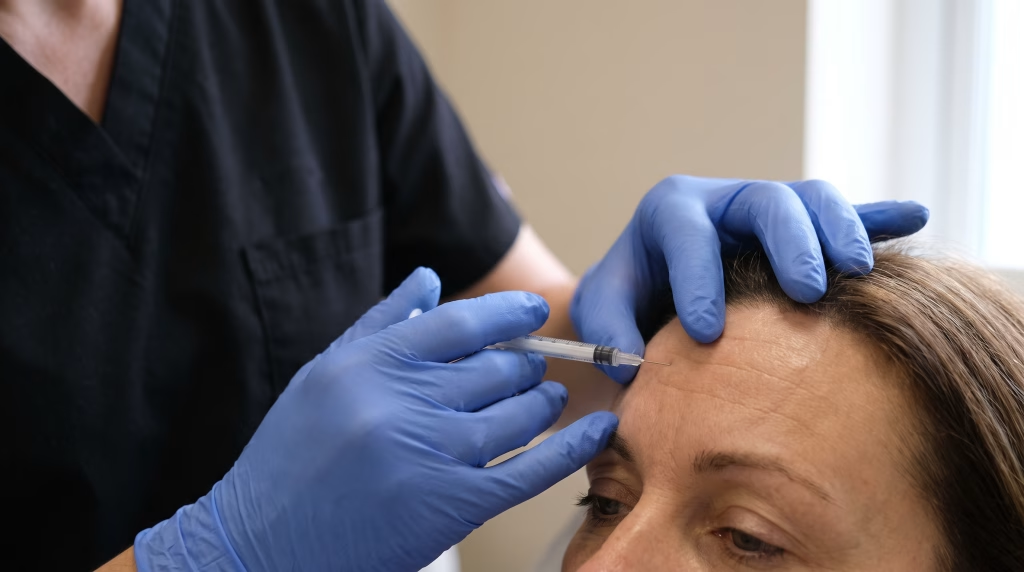
Anti-wrinkle injections (commonly known as Botox, the brand name for botulinum toxin) typically show nothing on day 1, start softening movement around day 3 to 5, and reach the finished result by day 14. That’s the honest rhythm many want before they stare in the mirror the next morning and start second-guessing everything.
And that first day can feel oddly anticlimactic. You’ve had the treatment, you’re watching your forehead or frown line area closely, and nothing seems different yet. That’s normal, and it’s usually the right sign at the start. The change happens gradually, not instantly, and the meaningful check point is the 14-day review, which is built into the process alongside the required £25 prescriber consultation before a first treatment. If you’re considering anti-wrinkle injections in Portsmouth, here’s exactly how the results unfold, day by day.
Table of Contents
- The Anti-Wrinkle Results Timeline at a Glance
- Day 1 What to Expect the Morning After
- Day 5 The Starting Point
- Day 14 The Finished Result and Why the Review Sits Here
- Normal Variation What Faster or Slower Onset Really Means
- First Timers Versus Returning Clients
- Personal Factors That Influence Timing
- Booking Your Consultation and What Happens Next
The Anti-Wrinkle Results Timeline at a Glance
A patient walks out of clinic, looks in the mirror the next morning, and expects the forehead to look different already. That is usually the wrong expectation. Day 1, nothing much yet. Day 5, it’s starting. Day 14, it’s done. That is the simple timeline I give in consultation because it keeps the focus on what happens, not on hoping for instant change.

The reason anti-wrinkle injections do not work straight away is simple. The product has to settle into the muscle and interrupt the signal that tells it to contract. A mechanistic review describes that initial weakening does not occur for several days, with peak effect over several weeks, and strength generally returning to normal by 3 months. A PubMed review reports that effects can be seen on the first to fourth days, with maximum effect in 1 to 4 weeks, then resolving after 3 to 4 months.
That is why the 14-day point matters. I use it as the proper review point, not because nothing happens before then, but because the treatment is still settling before that. A clinical study review found the median duration of effect for facial wrinkle treatment was 17.8 weeks (125 days) by physician assessment and 20.5 weeks (144 days) by participant assessment, measured from day 30. In plain terms, the change builds gradually at the start, then holds for months rather than days.
If you want the service details, the treatment page for anti-wrinkle injections shows how the appointment and review are handled.
Practical rule: if you are checking your face before day 14, you are checking too early.
Day 1 What to Expect the Morning After
The most common reaction on day 1 is to look in the mirror and think, “Nothing’s happened.” That is exactly what I expect. The muscle-relaxing effect has not started yet, so your lines can still look the same the next morning.
What you may see instead are tiny pinprick marks, a bit of redness, or a slight raised spot where the needle went in. Those are surface signs from the injections themselves, not a sign that the treatment has failed or that anything is wrong. They usually settle quickly, and they do not tell you anything useful about the final wrinkle-relaxing result.
The first morning after treatment
I would rather a patient told me, “It looks unchanged,” than started worrying because they expected instant softening. On day 1, the job is to let the product settle. The face is still capable of moving in the usual way, and that is fine.
If you wake up the next day and your forehead still moves, that does not mean the treatment has not worked. It means you are still on day 1.
The mistake I see is people over-reading every tiny sensation. A slight tight feeling can happen, but it is too soon to judge shape, balance, or smoothness. If you asked for movement to be kept, that was decided when I injected, not now — I have written separately about natural-looking anti-wrinkle injections. The result has not arrived yet, so the sensible move is to leave it alone and let the timeline run.
That is also why I tell patients to follow House of Glam HQ’s aftercare advice and avoid trying to test the result early. Push, frown, and mirror-checking in the first 24 hours will not speed anything up. It usually just makes you notice normal variation that would not matter later in the week.
Day 5 The Starting Point
Day 5 is often the first point when a patient says, “I can feel it starting.” The change is usually subtle, but it is real. Movement in the treated area begins to soften, so a frown feels less forceful, a brow lift feels less sharp, and the lines at rest can look a little less deep.
That first shift can feel oddly precise. You raise your brows and the movement does not hit quite as hard as before. You try to frown and the muscle feels a bit blunted, as if it has lost some of its snap. That is the point where the treatment stops being theoretical and starts showing itself in the mirror.
The normal range around day 5
Some people notice softening as early as day 2 or 3. Others do not really spot a change until day 5 to 7. Both sit within a normal range, and neither one is a reason to rush to judgement or try to force the result along.
I usually tell patients not to stare at one line in a magnifying mirror and compare it with yesterday’s reflection. Small changes can be genuine even when they are not dramatic. The result is still building, and the final shape has not settled yet.
Trying to test the area early does not help. Repeated frowning, mirror-checking, or pushing for movement will not make the product work faster. It usually just makes normal variation feel more noticeable than it really is.
If you are comparing your own progress with the broader before-and-after pattern, the guide to keeping natural movement sits alongside this timeline and explains what a settled result should and should not look like.
What you’re looking for on day 5: less resistance when you move, softer lines at rest, and a more relaxed feel in the treated area.
Day 14 The Finished Result and Why the Review Sits Here
Day 14 is the point where I would call the result complete. By then, the injections have settled, the movement has softened properly, and the area should look calmer without losing a natural range of expression. That is the aim of the treatment, to soften the lines while keeping the face looking like you.
This is also why the 14-day review sits here, rather than earlier. An appointment before two weeks can be too soon, because the treatment may still be changing. At two weeks, I can assess the end result properly, compare both sides, and decide whether one small area needs a touch more product.
What happens at the review
The review is a clinical check, not a formality. I look at symmetry, the amount of softening, and whether the treated muscles have settled evenly. If a small area needs a minor top-up, that is the point to consider it, because topping up at 14 days is part of normal clinical judgement, not a sign that something has gone wrong.
Day 1 is the starting point, day 5 is the first visible shift, and day 14 is the decision point. That is why judging the result on day 3 or day 4 so often leads people off track. You are looking at a work in progress and treating it as though it has already finished.
If you want the longer view, the anti-wrinkle injection timeline shows how the result usually holds once it has settled.
Best practice: wait for the 14-day review before deciding whether the result is balanced.
Booking your first treatment
One area is £170, two areas £210 and three £250, plus the £25 prescriber consultation that is legally required before a first treatment and paid once per prescription period. The fourteen-day review is included, which is exactly the point on this timeline where the result is worth judging. Klarna is available on treatments over three monthly payments.
Normal Variation What Faster or Slower Onset Really Means
A patient may walk out expecting the face to change in a straight line, then notice the pace feels uneven. That is normal. Some areas soften quickly, others take longer, and the difference between one side and another can look more obvious before the treatment has settled.
The point is not to chase the fastest onset. A quicker change does not automatically mean a better outcome, and a slower start does not mean the treatment has failed. I judge the result at 14 days, because that is the point where the effect has usually settled enough to assess properly.
Why timing can look different between people
The face is not a single unit, and each injection area responds in its own way. One person may see movement ease sooner in the forehead, while the frown lines take longer. Another may notice the opposite pattern. That is why I do not read too much into day 3, day 4, or even day 6 on their own.
There is also a practical trade-off here. Trying to force a faster result by adding more product too early can muddy the picture, not improve it. The better approach is to let the treatment do its job, then review it once the effect has had time to settle.
If you are unsure in that middle period, wait for the review. That appointment exists to separate normal variation from a result that needs a small adjustment. The same point is covered in House of Glam HQ advice on avoiding a frozen look, which is useful if you are worried about looking overdone before the treatment has fully settled.
Early change and late change can both be normal. The meaningful result is the one that holds at two weeks.
First Timers Versus Returning Clients
The basic timeline is broadly the same whether it’s your first treatment or your tenth. The product still needs a few days to begin softening movement, and it still takes around two weeks to see the finished result. The biology doesn’t change just because you’ve had it before.
First-timers often notice the effect more strongly because the contrast is bigger. Going from full movement to a relaxed look can feel obvious, even when the actual timeline is unchanged. Returning clients sometimes describe the change as more familiar, because they already know what the transition feels like.
The one real difference is how the result feels
People who have regular maintenance sometimes feel the benefit lasts a little longer over time, but that’s about longevity rather than onset speed. It doesn’t mean the treatment suddenly starts working faster on day 2. It just means the muscles may respond differently over repeated sessions.
I’d still give the same answer in consultation either way, first few days to start, 14 days for the finished result. That’s the honest timeline for both a new patient and someone coming back for maintenance. And it’s why I don’t overcomplicate the first appointment, because the waiting pattern is predictable even when the experience feels new.
Personal Factors That Influence Timing
A few personal factors can nudge the timeline a little, but they usually don’t change the overall pattern. Muscle strength is one. Stronger, more active muscles can take a touch longer to fully relax, or may need a little more product to get the same result.
Metabolism is another, though I think it gets blamed for too much. It matters more for how long the result lasts than for how quickly you first see it, but it still contributes to natural variation. Treatment area matters too, because smaller, more delicate muscles around the eyes often respond slightly quicker than a larger, stronger forehead muscle.

What won’t speed it up
Nothing you do on the day will make anti-wrinkle injections work faster. No product, no facial exercise, no shortcut changes the fact that the medicine settles into the muscle over days. That’s why online tips about “speeding it up” usually miss the point.
Don’t chase an early result. Let the treatment settle, then judge it properly at 14 days.
That’s the honest guard I give patients. If you try to read too much into day 2 or day 4, you’ll usually create stress where none is needed. Wait for the review, then decide what the result is.
Booking Your Consultation and What Happens Next
Anti-wrinkle injections use a prescription-only medicine, so a prescriber consultation is required before the first treatment, and the 14-day review is included. That is part of the safe process, not an extra layer added on top. I keep the first appointment focused on whether the treatment is suitable, which areas we are treating, and what you should realistically expect as the product settles. Every treatment is performed by me personally, Natasha, as sole practitioner at House of Glam HQ in Southsea.
The booking stage should also give you a clear idea of the timeline before you leave the chair. Day 1 can feel very ordinary, day 5 is often where patients first notice movement changing, and day 14 is the point where I judge the finished result with you. Trying to push for a faster onset usually creates unnecessary worry, because the medicine still needs time to settle into the muscle. That is why I do not encourage patients to keep testing the area or reading too much into the first few days.
What you should expect from any clinic is simple, a clear treatment page, a direct consultation route, and aftercare that tells you exactly when to expect change.
If you are ready to talk through your own timeline, email houseofglamhq@gmail.com or call 07831 846273. You can start with the anti-wrinkle injections service page and then read the related article on how long anti-wrinkle injections take to work if you want the broader onset picture as well.
If you want honest anti-wrinkle injections with a proper day-by-day plan, House of Glam HQ in Southsea keeps it simple, with treatment, review, and aftercare handled properly from the start. Visit House of Glam HQ to book your consultation and get the timeline explained before you sit in the chair.