Almost everyone who books polynucleotides with me asks the same question before they pay, and it is not about the price. It is some version of when will I actually see something. Fair enough. You are being asked to commit to a course of three to six appointments, three to four weeks apart, for a treatment that does nothing visible on the day.
So here is the honest answer, and then the detail behind it. Polynucleotides work over weeks, not days. The skin keeps changing for a few weeks after every session, and the result you are paying for arrives gradually across the whole course rather than at any one appointment. If you want something that looks different when you walk out of the room, this is the wrong treatment and I would rather say so now than take your money twice.
How long does it take to see results from polynucleotides?
Weeks. Not hours, not the next morning.
What I tell people in clinic is that polynucleotides do not sit in your skin and fill something out. They are injected into the skin to support its own repair, and the research on them describes an effect on collagen and elastin. That repair takes time to happen, which is the whole reason the treatment is sold as a course and not as a single appointment.
The product itself is gone quickly. Polynucleotides break down within weeks of injection, and what lasts is the repair they trigger. So the thing you are waiting for is not the product settling, the way filler settles. It is your own skin responding.
In practice that means the change creeps up on you. Most people notice it in the mirror at some point between sessions rather than on a particular day, and plenty of people are told by someone else before they spot it themselves.
Why there is no instant change, and why that is the point
This is the part that gets confused most often, so it is worth being plain about it. Polynucleotides are not a dermal filler. Filler restores structure and you can see it immediately, because there is physically something there that was not there before. Polynucleotides add no volume at all. Nothing about the shape of your face changes.
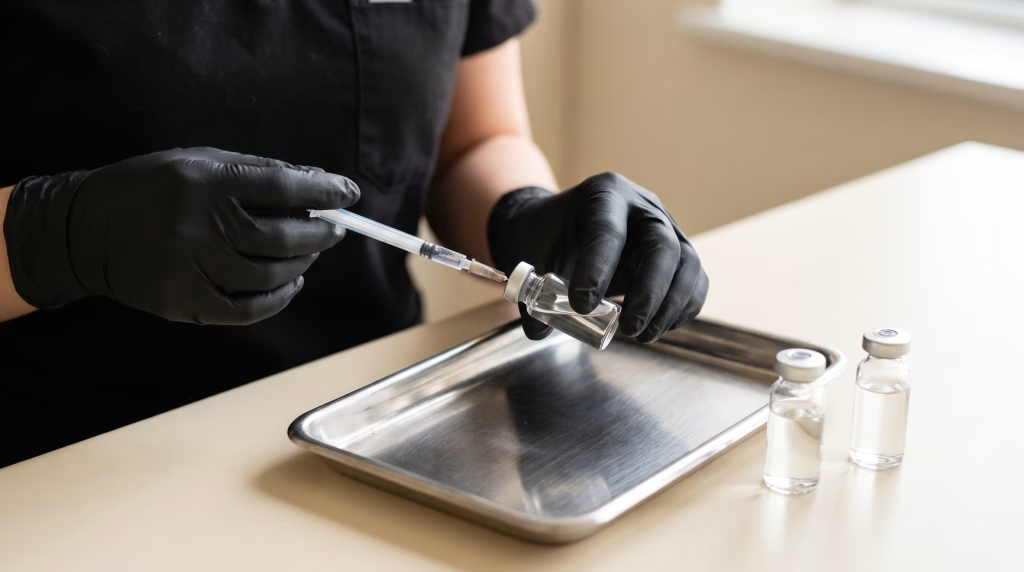
If you hold the two products side by side, one is a thin solution and the other is a thicker gel, and they are doing completely different jobs. That difference is why one shows instantly and the other does not.

So if the thing bothering you is a shape or a loss of structure, polynucleotides will not fix it however long you wait, and I will tell you that rather than sell you a course of them. Dermal fillers are what changes structure. Polynucleotides treat the condition of the skin.
What the first 48 hours look like
You will see something straight after your appointment, and it is not the result.
Polynucleotides go in as a series of small injection points across the area, and those points leave small raised bumps where the product went in. They usually settle within 24 to 48 hours. Most people go straight back to work with them. They are a sign the product is where it should be, not a preview of what your skin is going to look like.

For the first 24 hours: no heavy exercise, no saunas, no steam, and leave the area alone. That is the whole list. A stronger reaction does not mean a better outcome, and there is nothing you need to do to make the treatment work faster.
Week by week, what usually happens
I am reluctant to publish a day-by-day chart, for reasons I will come to. But the rhythm of a course is consistent enough to be useful:
| When | What usually happens |
|---|---|
| The appointment | 40 to 45 minutes, including numbing cream and the assessment at the start |
| Day one to two | Small raised points where the product went in, settling on their own |
| The weeks after each session | The skin keeps changing. This is where the result is actually built |
| Three to four weeks on | Your next session in the course |
| After a full course of three to six | Most clients find the result holds for around six to nine months |
Notice what that table does not contain. There is no row that says “day seven, glow appears”. I am not going to put one in, because I cannot promise you a day.
Why I will not give you a day number
You can find a different figure on every clinic website you open. Seven to ten days. A few days. Four to six weeks. Eight to twelve weeks. They cannot all be right, and the reason they differ is that nobody can tell in advance how quickly a particular person’s skin will respond.
What I can tell you is what I have seen and what the treatment is doing. Results develop over weeks rather than appearing as one dramatic change, and they vary from person to person. A number precise enough to put in a headline is a number precise enough to be wrong, and you would be the one who paid for it.
That honesty cuts both ways. If you are three sessions in and genuinely nothing has changed, I would rather you told me, and we looked at whether polynucleotides are the right treatment for your skin, than you quietly booked a fourth.
How long do polynucleotides take to work under the eyes?
The same answer, with one extra thing worth knowing.
Three of the six products I use are made specifically for the under-eye area: Dermis Glow Eyes at £135, Vitaran Eyes at £150 and Lumi Eyes at £150. Dark circles are easily the most common reason people ask about them, and the under-eye skin is thin enough that numbing cream matters more here than anywhere else on the face.
The honest caveat is this. Some dark circles are a skin quality problem, and polynucleotides can help those. Some are shadow cast by the bone structure, or pigment sitting in the skin, and no amount of time will make polynucleotides fix those. That is a conversation to have before you book a course, not three sessions in. There is more detail in my guide to polynucleotides under the eyes, including what they will not do for hollowing.
How many sessions before you see the full result?
A course is usually three to six sessions, three to four weeks apart, and what the 48 hours after each one look like is set out separately. Each one is booked and paid for on its own, so there is no package to commit to up front, and I will tell you at your first appointment how many I think you need rather than defaulting to six.
The full result is not sitting at the end of session one waiting for you. It accumulates. Each session adds to the repair the last one started, and the skin carries on improving in the gaps between them, which is why the spacing is three to four weeks rather than a fortnight.
How long do the results last once they arrive?
Once a course is finished, most clients find the result holds for around six to nine months, though it varies from person to person.
That is the figure for polynucleotides specifically. If you are weighing them against the HA skin boosters I also offer, Seventy Hyal 2000 and Profhilo, the longevity question is a different one and I have answered it separately in how long skin boosters last.
Polynucleotides or a skin booster?
Both treat skin quality rather than shape, and both work gradually, so the timeline question applies to each of them. The difference is what is in the syringe. Polynucleotides are derived from salmon trout DNA and support the skin’s repair. Seventy Hyal 2000 at £165 and Profhilo at £185 are hyaluronic acid.
Which one I would use depends on your skin and on the area, and that is a two-minute conversation rather than a research project. If you want the reasoning in full, do skin boosters work sets out what HA boosters change and who they suit, and polynucleotide skin boosters explained covers the science side of this treatment in more depth.
What polynucleotides will not do
Worth saying plainly, because it saves people money:
- They add no volume. Nothing here changes the shape of your face.
- They will not lift anything. Loss of structure is a different treatment.
- They will not work overnight, and nothing you do at home speeds them up.
- They are not offered during pregnancy or while breastfeeding, and every treatment here is for adults only.
- They are derived from salmon trout DNA, so a fish allergy needs discussing before you book, not on the day. So does any active infection or breakout in the area.
Polynucleotide prices in Portsmouth
Every price is published, where most Portsmouth clinics quote only after a consultation. These are the six I offer, and each one books straight to its own slot on Fresha at the price you see here.
| Treatment | Per session | Appointment |
|---|---|---|
| Dermis Glow Eyes, under-eye | £135 | 40 minutes |
| Vitaran Eyes, under-eye | £150 | 45 minutes |
| Lumi Eyes, under-eye | £150 | 45 minutes |
| Dermis Glow Face, full face | £155 | 45 minutes |
| Lumi Pro, full face | £155 | 45 minutes |
| Vitaran, full face | £185 | 45 minutes |
A course of three Dermis Glow Eyes sessions comes to £405, and three Vitaran face sessions to £555. You pay per appointment as you go. Klarna spreads a treatment over three monthly payments. Full detail on each of the six, and who they suit, is on the polynucleotides in Portsmouth page, and the wider skin booster cost comparison sets these against the HA options.

Booking polynucleotides in Portsmouth
There is no consultation to get through first. Pick the treatment on Fresha and the assessment happens at the start of that appointment with no separate fee. If you would rather talk it through before committing to anything, a standalone consultation is £15 and comes off your treatment when you go ahead.
I carry out every House of Glam HQ treatment personally, at 1A Auckland Road East in Southsea, and clients travel for polynucleotides from across Portsmouth, Havant, Fareham, Gosport and the rest of Hampshire.
If you are not sure which of the six fits, message me and tell me what is bothering you. I will tell you which one I would use, how many sessions I think you need, or whether something else would serve you better.
Book polynucleotides on Fresha · WhatsApp Natasha · call 07831 846273

