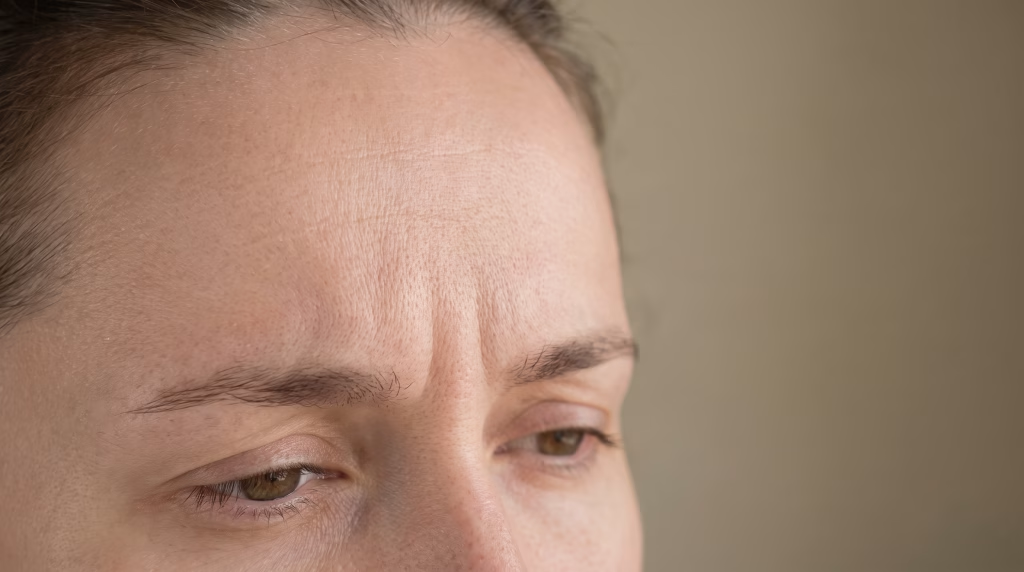
You’ll usually start to see a change from anti-wrinkle injections in 3 to 5 days, and the full result takes a full 14 days to settle. That 14-day mark is the one that matters most.
The question I hear all the time is this: if you can see a tiny change early, does that mean it’s already worked? No. Anti-wrinkle injections work gradually as the product settles into the muscle, so an early flicker of softening is encouraging, but it isn’t the finished result.
I’m Natasha, sole practitioner at House of Glam HQ in Southsea, Portsmouth, and I’ve been treating anti-wrinkle areas for 7+ years. I’m always direct about this because it saves people a lot of unnecessary stress. If you’re checking the mirror on day 3 and wondering whether it’s failed, you’re usually judging it too early. When you book anti-wrinkle injections in Portsmouth with me, your 14-day review is timed to catch the full result rather than the halfway stage.
The Honest Answer to How Long Injections Take to Work
How long do anti-wrinkle injections take to work, if you want the honest clinic answer rather than the hopeful version? These are botulinum toxin injections, which most people know by the brand name Botox, and the change comes on gradually.
In practice, I tell clients to expect the first signs of change over the first few days, with the final effect judged at the two-week point. That slower build is normal. It reflects the biology of how anti-wrinkle injections reduce muscle activity over time, rather than giving an instant visible result.
If you are considering anti-wrinkle injection treatment, it helps to start with realistic expectations. Aftercare protects your result, but it does not make the product work faster. Good aftercare matters because it lowers the chance of avoidable problems. It does not override the timeline your body follows.
Why results are gradual
Clients often expect to leave clinic and look smoother that same evening. That is not how this treatment behaves.
The product needs time to affect the nerve signals going to the treated muscle. As movement starts to reduce, lines begin to soften. Some areas show that change sooner than others, and some people notice a feeling of tightness before they see much difference in the mirror. Neither is a reliable sign that the final result has settled.
For an accurate assessment of whether it has worked, wait until day 14.
What I tell clients in clinic
I keep this part very direct. Avoid judging the outcome too early, avoid comparing one side to the other in the first few days, and avoid chasing extra treatment before the original plan has had time to settle.
The honest truth is simple. Patience protects you from unnecessary worry, and it also protects you from being overtreated.
Your Day-by-Day Results Timeline
What should you expect to see after treatment, and when should you start paying attention to the mirror?

I give clients a simple rule. Watch for gradual change, not instant perfection.
Days 1 to 3
The first day is usually uneventful from a visual point of view. You may see tiny injection marks or mild swelling at the treatment points, but you should not expect lines to look smoother yet.
By day 2 or 3, some clients notice that certain expressions feel weaker or slightly restricted. I often hear, “It feels different, but I can’t quite see much yet.” That is a normal stage. Feeling a change before seeing a clear result happens often, especially in smaller treatment areas.
Days 4 to 7
This is the awkward middle stage. Movement is starting to reduce, but the result can still look uneven from one day to the next.
One eyebrow may seem more active. The forehead may still crease more than expected. A frown line may look softer in certain lighting and unchanged in others. None of that means the treatment has failed.
I tell clients not to judge the outcome during this window. The product is still taking effect, and aftercare does not speed that up. Good aftercare helps protect the area while the treatment settles, but biology still sets the pace.
Early improvement is only that. Early.
Days 10 to 14
By this point, you can usually see the result clearly enough to assess it properly. The treated muscle should be working less, and the skin over it should look smoother at rest and during expression, depending on the treatment plan.
This is also why I advise clients to wait until the full two-week mark before deciding whether anything needs adjusting. Reviewing too early creates a real risk of overtreatment, especially if someone reacts to a temporary imbalance that would have settled on its own.
If you want a clearer idea of what a settled outcome can look like, my results timeline is more useful than comparing your face on day 3 with day 5.
A simple way to think about it
| Time after treatment | What’s normal |
|---|---|
| Day 1 | Little to no visible change |
| Day 2 to 3 | Early softening or reduced movement for some clients |
| Day 4 to 7 | Partial result, sometimes with mild side-to-side differences |
| Day 10 to 14 | Settled result, suitable point for proper assessment |
That timeline keeps expectations realistic. It also stops people from doing the two things that cause the most unnecessary worry, checking too often and judging too soon.
Factors That Influence Onset and Effectiveness
Two people can have the same area treated and still see different timing. That doesn’t automatically mean one treatment was better done than the other. It usually comes down to anatomy, dosing, and how your muscles behave.

Muscle strength changes the pace
The forehead is a good example. For a lot of people, it’s a larger, stronger muscle, so it can take a touch longer to soften fully. Crow’s feet and the frown area often show change a little sooner because those muscles are smaller and more delicate.
But I wouldn’t read too much into tiny day-to-day differences. One person’s forehead can respond quicker than another person’s crow’s feet. That’s why I assess the final settled result at review, not halfway through the process.
Dose affects both onset and longevity
Dose is one of the biggest trade-offs, and it’s where honest advice matters. According to this explanation of dosing and onset, lighter, natural dosing (6–12 units) may show subtle effects in 2–3 days but last only 6–8 weeks, whereas higher doses (20+ units) can delay full relaxation to 7–14 days but sustain results for longer.
That’s why “faster” isn’t always “better,” and “stronger” isn’t automatically right either.
A softer result may suit someone who wants movement preserved and a more understated look. A stronger plan may be more appropriate if the muscle is very active and the goal is more hold. This is also why area count and treatment planning matter. If you want to understand how treatment is mapped out by area, personalized anti-wrinkle treatments in Portsmouth gives a useful starting point.
Previous treatment can make a difference
First-time treatments can feel slower because the muscle hasn’t been conditioned yet. Repeat treatments can sometimes feel quicker because the muscle is already less dominant from previous sessions.
That doesn’t mean everyone follows the exact same script. It means there’s a normal range, and good treatment planning works with that rather than pretending every face behaves identically.
Pricing and planning
This is also where pricing fits in sensibly. Anti-wrinkle injections start from £170 for 1 area, £210 for 2 areas, and £250 for 3 areas. The right plan depends on movement, muscle strength, and what result you want, not on chasing the fastest possible onset.
What Aftercare Does and What It Does Not Do
Many myths stem from this curiosity. People want to know if there’s a trick to make anti-wrinkle injections kick in faster.
There isn’t.

What aftercare does not do
No cream, massage, facial gadget, or home hack will speed up the biological onset. The product settles into the muscle over days. That timeline is the timeline.
If anyone tells you they can make it “kick in faster”, I’d be cautious. That isn’t being straight with you.
Follow the aftercare to protect the result, then let it settle in its own time.
What aftercare actually does
Aftercare is about protecting placement and reducing the chance of product migration while everything settles.
MHRA guidance emphasises avoiding strenuous exercise, lying down, or facial massage for 4–6 hours after treatment to help preserve intended anatomical targeting.
For the first 24 hours, I advise clients to keep it simple:
- Stay upright for around 4 hours, don’t lie flat straight after treatment.
- Don’t rub or massage the treated areas, even if you’re tempted to check them.
- Skip exercise, heat and alcohol for that first day.
- Leave the area alone, let it settle where it was carefully placed.
That’s the primary purpose of aftercare. It doesn’t accelerate the onset. It helps the treatment work where it was intended to work.
The Importance of Your 14-Day Review
Wondering why I ask you to wait until day 14 before deciding whether your anti-wrinkle treatment has worked properly? Because that is the first point where I can assess the true result rather than a result that is still developing.
At my clinic, the 14-day review is included with every anti-wrinkle treatment. I use that appointment to check how each area has settled, how the muscles are responding, and whether the outcome matches what we planned.
I do not judge a result too early. If you still have some movement at day 4, 5, or 7, that is not automatically a problem. It often means the treatment is still taking effect. Adding more product before the full effect is visible can leave a client heavier, flatter, or less natural than intended.
The honest answer is simple. The review protects the final result because it happens when the treatment can be judged properly, not when you are still in the waiting period.
That timing matters for another reason. The goal is not to freeze every trace of movement at all costs. The goal is a balanced result that suits your face, your muscle strength, and the look you wanted in the first place.
At the review, I look at:
- symmetry at rest and in movement
- how strongly the treated muscle is still contracting
- whether one side has responded faster or more fully than the other
- whether a small adjustment is appropriate, or whether no change is the better decision
Sometimes a client expects etched-in lines to disappear in the same way dynamic lines soften. That is where honest advice matters. Anti-wrinkle injections reduce muscle activity. They do not resurface the skin, and they do not erase every static line.
If your concern is skin texture rather than movement, I will say so plainly and point you toward a resurfacing treatment such as microneedling in Portsmouth, but only if it is relevant to your goal. That is a better standard of care than adding more product just because the calendar feels impatient.
Ready to Discuss Your Treatment?
Want a clear answer on whether treatment is right for you? Start with a proper consultation. Anti-wrinkle injections are a prescription-only medicine, so a £25 prescriber consultation is required before a first treatment.
I carry out every treatment myself and keep the process prescriber-compliant under JCCP guidelines. Clients see me one-to-one in Southsea, Portsmouth, with no hand-offs and no rushed decisions.
If you are still deciding, have a look at my anti-wrinkle injection prices and treatment areas and focus on what matches your concern. I will always say if anti-wrinkle injections are a good fit, and I will say just as plainly if they are not. That matters, because good treatment planning is about choosing the right option, not chasing the fastest appointment.
Prices for anti-wrinkle injections start from £170 for 1 area, £210 for 2 areas, and £250 for 3 areas. True value, though, is careful dosing, realistic expectations, and review at the right point in the timeline. Aftercare helps protect your result. It does not make the product work faster, and I would rather tell you the truth upfront than promise shortcuts that do not exist.
If you want to talk it through, call 07831 846273 or email houseofglamhq@gmail.com to arrange your consultation.

