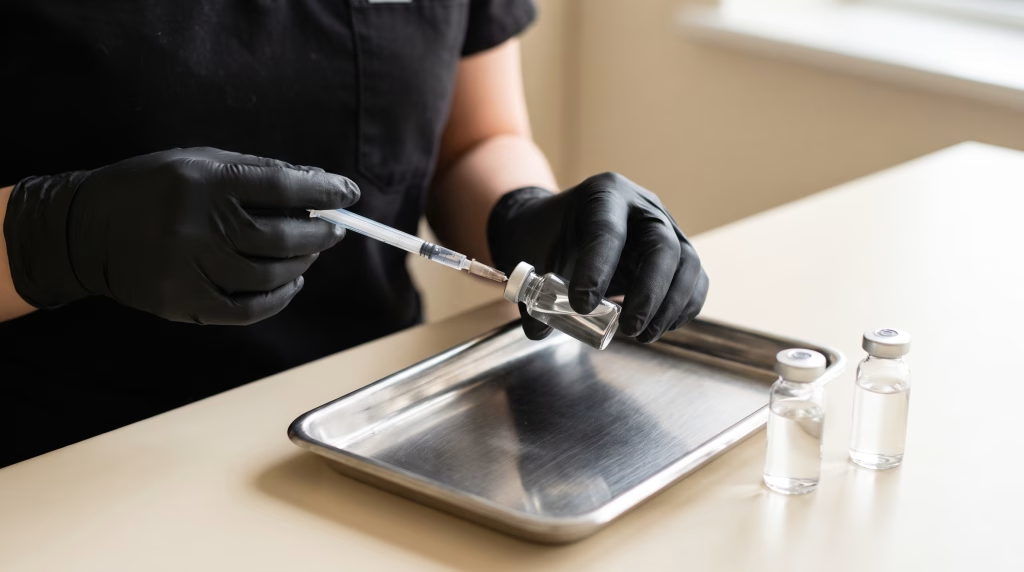
Skin booster results usually last around 4 to 9 months, with maintenance most commonly planned at about 6 months. The window changes according to the product, the treatment course, your skin and what you mean by the result still lasting.
The tidy answer you'll see online is often three to six months. That's easy to remember, but it isn't a reliable plan for everyone. In my Southsea clinic, I look at the product used, whether the recommended course was completed, how the skin responded and when the improvement starts to fade.
I'm Natasha, sole practitioner at House of Glam HQ in Southsea, Portsmouth. I've worked clinically in aesthetics for more than seven years, and I'd rather give you a realistic maintenance plan than promise a fixed glow that no injectable can guarantee.
Why a Single Timeline Is the Wrong Question
A skin booster doesn't switch on at one precise moment, then stop working on a fixed date. The first change can come from hydration, while the broader skin-quality response develops more gradually. That means “lasting” might mean your skin still feels more hydrated, fine lines remain softer, or the visible radiance is still better than your starting point.
UK-facing guidance commonly places results across a broader 4 to 9 month range, with some people noticing fading earlier and others retaining benefits for longer depending on the product, skin type, metabolism and lifestyle. Maintenance appointments are often advised every 4 to 6 months in practical clinic guidance, while other UK sources commonly use six-month maintenance as the working interval.
What changes the answer
The product matters first. Profhilo is commonly discussed around six months after its two-session course, while other hyaluronic-acid boosters are often quoted at roughly four to nine months in UK-facing guidance.
The protocol matters too. A single appointment isn't equivalent to a completed course, and a course isn't equivalent to a maintenance top-up. If you book one session, judge the result as if you've completed the whole plan, then you're likely to expect too much from too little treatment.
Practical rule: Ask, “How long should this product last after the recommended course?” That's a better question than asking for one universal number.
The evidence also needs careful reading. A recent clinical review notes that some skin-booster studies are rarely followed beyond 1 to 3 months, while an updated review reports that the duration of effect generally averages about 6 months after three treatment sessions (the clinical review in PMC). Marketing pages can sound more certain than the independent evidence allows.
What a Skin Booster Actually Does Under the Skin
A skin booster is an injectable skin-quality treatment, not a conventional dermal filler. It's designed to improve hydration, texture and the appearance of fine lines. It isn't used to build a cheek, reshape a chin or create lip volume.
Most products used for this purpose contain hyaluronic acid, a substance that attracts and holds water. The material is placed through small injections into the dermis, where it spreads through the tissue rather than behaving like a firm gel that holds a sculpting position.

Why the effect develops gradually
There are two overlapping parts to the result:
- Early hydration: Hyaluronic acid binds water, which can make skin look fresher and feel more supple.
- Slower remodelling: The treatment response continues over the following 4 to 8 weeks, as the skin responds to the injectable material and its environment.
- Eventual breakdown: The body metabolises the hyaluronic acid, so the effect is temporary rather than permanent.
That last point is why longevity varies. The product doesn't sit unchanged in the skin forever. Your enzymes break it down, and the visible benefit gradually reduces. Any improvement in skin quality doesn't create a permanent replacement for the original treatment.
Skin boosters therefore suit someone who wants better hydration and a fresher texture, but they aren't the right answer for every concern. Significant volume loss, dynamic lines caused by muscle movement and marked laxity need a different discussion.
For home care, topical hyaluronic acid is a separate matter from injectable treatment.
At House of Glam HQ, the relevant treatment is skin boosters, including Profhilo and Seventy Hyal. I assess whether hydration-focused injections match the concern before discussing timing.
Profhilo vs Seventy Hyal and Why Longevity Differs
Profhilo and Seventy Hyal are both hyaluronic-acid skin boosters, but their longevity should not be treated as interchangeable. The formulation, injection pattern and strength of available long-term evidence all affect how confidently a result can be predicted.
Profhilo is usually delivered as two sessions spaced four weeks apart. UK guidance describes benefit continuing after the hyaluronic acid is metabolised, with clinical improvement often persisting for around 6 months after the course. Some UK-facing sources place visible results at around 6 to 9 months, although individual responses vary.
Seventy Hyal is commonly discussed in the 6 to 9 month range, but independent long-term evidence is thinner than the confident claims used in some treatment marketing. If treatment stops part-way through the recommended protocol, the published longevity range may not apply. The expected result depends on the amount delivered and the protocol completed, not the product name.
Comparing the two approaches
| Product | Typical course | Realistic longevity | Maintenance pattern |
|---|---|---|---|
| Profhilo | Two sessions, four weeks apart | Around 6 months after the course, with some UK guidance describing 6 to 9 months | Often around 6 months, sometimes 6 to 12 months depending on skin and lifestyle |
| Seventy Hyal | A course may involve two to three sessions, spaced according to the treatment plan | Roughly 6 to 9 months is commonly discussed, but evidence is less established | Often every 4 to 6 months in practice |
The table is a planning guide, not a promise. It also shows why comparing the longest figure for one product with the shortest figure for another can produce a misleading answer. In practice, I look at how long the improvement remains useful to the patient, rather than treating fading as an exact expiry date.
For the Profhilo protocol and its limitations, the House of Glam HQ Profhilo guide provides the treatment-specific explanation.
The Factors That Quietly Change How Long Results Last
Longevity isn't determined by age alone, and I won't tell someone that a faster metabolism automatically means their result will disappear on a particular date. The evidence supports a range, not a precise personal countdown.
Four variables I consider
Treatment area affects the experience of duration. Thinner, more mobile or more exposed skin can show fading sooner than a less mobile area. The neck and hands are exposed to movement, washing and environmental stress, while facial areas differ in thickness and activity.
Metabolism may influence how quickly hyaluronic acid is cleared. A Southsea runner with a high exercise load may feel ready for a top-up sooner than a desk-based patient of the same age, but that's an observation to discuss during review, not a guaranteed rule.
Lifestyle can affect the skin's condition while the product is present. Smoking, heavy sun exposure and poor sleep don't create a fixed number of months that can be deducted from your result. They can make the skin look less healthy and may reduce how long the improvement feels worthwhile.
Baseline skin quality changes the starting point. Someone with dry, photoaged or crepey skin may notice a useful response but may also feel the difference fade earlier than someone whose skin already holds hydration well.
| Factor | Shortens duration | Neutral | Extends the useful effect |
|---|---|---|---|
| Area | Thin, mobile or heavily exposed skin | Typical facial treatment area | Less movement and consistent skin protection |
| Metabolism | Faster clearance may mean earlier fading | No obvious pattern | Individual response varies |
| Lifestyle | Smoking, heavy sun exposure and poor sleep | Ordinary daily variation | Sun protection and steady skin care |
| Baseline skin | Marked dryness or photoageing | Moderate dehydration | Skin that already retains hydration well |
The same product can therefore feel different on two patients. That's why I ask about work, exercise, sun exposure and existing skincare rather than quoting a result window in isolation.
If your main concern is regeneration rather than hydration, polynucleotides treatment is a separate conversation. Polynucleotides aren't the same product category as hyaluronic-acid skin boosters, so I wouldn't use one treatment's timeline to describe the other.
What a Full Course Looks Like Week by Week
Most patients asking about Profhilo need to understand the course before they can judge how long it lasts. The first appointment is only the opening treatment, not the point at which the final result should be assessed.
The Profhilo timeline
Week 0: The first session takes place. The standard BAP approach uses five injection points on each side of the face. Mild swelling, redness or small raised areas can occur for around 24 to 48 hours, depending on the individual response.
Weeks 1 to 2: Early hydration may become noticeable. Fine lines can look softer, but this isn't the finished result. Normal routines can continue once the initial reaction has settled, following the aftercare provided.
Week 4: The second session is carried out, building on the first. Profhilo guidance commonly places these sessions four weeks apart, rather than treating the first appointment as a complete course.
Weeks 5 to 6: The skin-quality response develops. Hydration and texture may look more even, while the bioremodelling response continues.
Weeks 8 to 12: The result commonly feels more established. It's still too early to decide that it has failed because the first few days didn't produce a dramatic change.
Weeks 16 to 24: Gradual fading may become noticeable, which is when maintenance planning often becomes relevant. This doesn't mean everyone needs treatment at exactly week 16 or exactly week 24.

Seventy Hyal can use a different course structure, commonly involving three sessions at two-week intervals in the treatment plan described for this product. That stretches the initial schedule differently, so comparing the date of the first injection with Profhilo's final-course timeline can be misleading.
The your skin boosters guide covers the practical treatment process. I'd assess the settled response after the course, not judge the outcome by temporary swelling or the first day's shine.
Planning Maintenance That Fits Real Life
A sensible maintenance plan starts before the result has completely disappeared. If you wait until your skin has returned fully to its starting point, you may need to repeat the initial course rather than maintain the improvement with a simpler top-up.
For Profhilo, a practical pattern is one completed course followed by review around six months. Some people may discuss an earlier appointment around four months if their skin responds less strongly or the visible improvement fades sooner. UK commentary also mentions that some patients choose closer top-ups, but timing remains individual rather than fixed (Harper's Bazaar UK's discussion of Profhilo maintenance).
Use your own skin as the guide
Around weeks 16 to 20, check whether the changes that mattered to you are still present. Look at hydration, fine lines and texture in the same light rather than relying on one good or bad morning.
A simple pinch check can give you a rough sense of how supple the skin feels, but it isn't a medical measurement. The mirror check is more useful when you ask whether your original concern is returning, not whether your face looks exactly like it did on treatment day.
Book the second course appointment while the first result is still doing its job. Waiting until you're disappointed makes adherence harder.
Schedule around real events. If you have a wedding or holiday planned, leave enough time for the course and settling period rather than booking an injection immediately before a major occasion. Summer sun also matters, particularly if you're treating an exposed area.
For Seventy Hyal, the working pattern is often an initial course followed by top-ups every 4 to 6 months, adjusted to the product plan and your response. Maintenance isn't a guarantee that results will remain identical. It's a way to avoid repeatedly starting from the beginning.
Aftercare Realistic Outcomes and Booking in Portsmouth
The first 48 hours are about keeping irritation and swelling down. Avoid vigorous exercise, alcohol, saunas and heavy active skincare. Don't rub or press the injection sites, and follow the product-specific instructions I give you at the appointment.
Small bumps, redness, tenderness or bruising can occur after injectable treatment. These usually settle, but contact the clinic if you're concerned about a reaction or if symptoms aren't following the expected pattern. For general information about complications associated with non-surgical cosmetic procedures, the Joint Council for Cosmetic Practitioners guidance is a useful independent reference.
What results should feel like
Hydration and a fresher appearance may develop within 2 to 4 weeks, while skin quality and fine lines build across the full course. Results often feel more stable from around week six, but that doesn't mean the outcome is identical for every patient.
Skin boosters won't lift substantial loose skin, replace lost facial structure or relax expression muscles. If your concern is dynamic lines, anti-wrinkle injections are a different treatment. If you want facial shape or volume, dermal fillers are a different treatment again.
At House of Glam HQ, Profhilo is £185 and Seventy Hyal is £165. Skin boosters can be booked directly without a consultation first, deliberately. You can book the treatment and we'll discuss your medical history, skin, goals and budget at the start of the appointment. Klarna is available on treatments over three monthly payments.
I carry out every treatment personally at 1A Auckland Road East, Southsea, Portsmouth, PO5 2HA. House of Glam HQ is rated 5.0 on Google, Fresha and Facebook, but the practical point is that you'll see the same practitioner throughout, with no handover to another injector.
Skin boosters do not need a consultation first. If you want one for a different treatment, a standalone consultation is booked on Fresha with a £15 deposit, deducted from the treatment if you go ahead; booked with a treatment, it happens at the start of that appointment with no separate fee. Appointments are booked in advance, so plan the course before a fixed event.
Frequently asked questions
How long do skin boosters last after one session?
A single session may produce an early hydration change, but UK guidance generally discusses skin-booster benefits across roughly 4 to 9 months, depending on the product and patient. It shouldn't be judged as equivalent to a completed course.
Does Seventy Hyal last longer than Profhilo?
There isn't a reliable universal winner. Seventy Hyal is often discussed around 6 to 9 months, but the evidence base is thinner, and the protocol you complete matters more than a headline duration.
When should skin booster maintenance happen?
Maintenance is commonly planned around 4 to 6 months, with six months a practical starting point for many patients. Your skin's response and the product protocol should decide the final timing.
Are skin boosters the same as dermal fillers?
No. Skin boosters improve hydration, texture and skin quality. Dermal fillers are used to add or restore volume and shape. Both may contain hyaluronic acid, but they perform different jobs.
Do skin boosters give permanent results?
No. The injectable hyaluronic acid is metabolised, and the visible benefit fades over time. Maintenance can support ongoing results, but no permanent outcome should be promised.
Can I book skin boosters without a consultation first?
Yes. Skin boosters at House of Glam HQ can be booked directly without a separate consultation first. Medical history, suitability, product choice and aftercare are discussed at the appointment.
Book Skin Boosters in Portsmouth
Profhilo is £185 and Seventy Hyal 2000 is £165, and neither needs a consultation first. Book the treatment and we go through your skin, your history and the plan at the start of the appointment. Every price is published on the skin boosters page before you book, and Klarna is available on treatments over three monthly payments.
- Book on Fresha: Book with Natasha on Fresha
- WhatsApp: Message Natasha on WhatsApp
- Call: 07831 846273
- Email: houseofglamhq@gmail.com