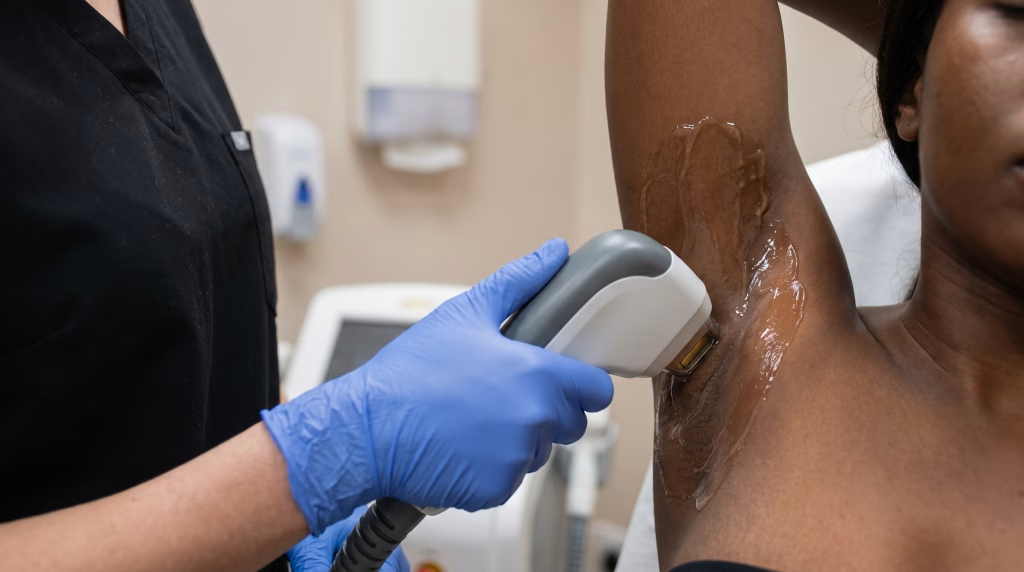
The short answer is yes, with conditions. Darker skin can be treated with laser, and it is treated safely every week in clinics up and down the UK. What decides how it goes is the wavelength, the settings, and whether the person holding the handpiece is willing to slow down or stop.
I’m Natasha, sole practitioner at House of Glam HQ in Southsea, Portsmouth. I’ve spent more than seven years treating a wide mix of skin tones and I do every laser session myself. Laser hair removal at my clinic is for women only. If your skin points towards a machine I don’t have, I’ll tell you that rather than book you in.
This page covers what is safe on deeper skin tones, what isn’t, what I won’t promise, and what every area costs. Prices start at £26 a session and the full list is further down.
Will laser hair removal work on dark skin?
Yes, on most deeper skin tones, with the right laser and careful settings.
Laser finds pigment in the hair and heats the follicle. Deeper skin has more pigment at the surface too, so some of that energy can be taken by skin rather than hair. Handled badly, that’s how people end up with a burn, or a patch that goes darker and takes months to settle. Handled properly, laser is a reasonable option for long-term hair reduction on deeper tones.
Which is why “safe for dark skin” on a clinic’s website means very little on its own. What matters is whether someone can tell you how they’re lowering the risk on your skin, rather than on skin like yours.
Why melanin makes it more complicated
A well-matched laser reaches the follicle without pulling too hard at the pigment in the top layer of skin. A poorly matched one is less fussy, and your skin absorbs heat that was meant for the hair.
Older systems were a real problem for deeper tones. Early laser hair removal suited lighter phototypes, and it was longer-pulsed diode and Nd:YAG systems that made treating darker skin sensible, used with conservative energy, longer pulse durations and more sessions.
The turning point was wavelength. A 1064 nm Nd:YAG travels deeper and is less readily absorbed by pigment in the epidermis, which leaves more room to target the follicle.
Better technology didn’t turn it into a preset-and-go treatment, though. Three things still go wrong:
- Copy-paste settings.
The same energy for everyone with a similar skin tone is lazy practice. - Cooling treated as optional.
Surface protection is doing real work, not decorating the appointment. - Treating a recent tan.
More pigment at the surface, less margin for the practitioner.
And three things make it work:
- A conservative starting point, particularly on Fitzpatrick V and VI.
- A patch test, because how your skin responds beats how it looks.
- Adjusting across the course rather than starting where you’d like to finish.
What type of laser hair removal is best for dark skin?
In UK-facing clinical guidance, Nd:YAG and diode are the two commonly placed as preferred for darker skin. Alexandrite is generally grouped with lighter skin types.
Nd:YAG gets most of the attention, and fairly. The longer wavelength reaches deeper and is less readily absorbed by pigment at the surface.
I don’t offer Nd:YAG. My device is a SMARTDiode. If your skin points towards Nd:YAG, I’ll say so and explain why, rather than treat you on a setting that doesn’t suit you. I’d rather lose the booking than give you a reaction.
| Laser | Usual fit for deeper skin tones | Offered at House of Glam HQ |
|---|---|---|
| Nd:YAG | Commonly placed first. Deeper penetration, less absorbed by surface pigment | No |
| Diode | Also commonly placed as preferred, when the settings are chosen carefully | Yes, a SMARTDiode |
| Alexandrite | Usually grouped with lighter skin types. More caution needed on deeper tones | No |
The full area list, with a booking link on every row, is on my laser hair removal in Portsmouth page.

How I choose settings
There is no single SMARTDiode setting I’d call the best for deeper skin. Anyone who tells you there is has stopped thinking about your skin and started thinking about the machine.
On deeper tones I start low, use longer pulse durations and make sure the cooling is doing its job, then watch how your skin answers. Some people move up quickly. Some need a slower climb, and that isn’t treatment failing. The laser doesn’t make the call. I do.
Is IPL safe for black skin?
I don’t offer IPL, so I’ve nothing to sell you either way.
IPL is broadband light rather than a single wavelength, which means more of what it emits is available to be absorbed by pigment in your skin. That’s the reason UK guidance for deeper skin tones generally points at a laser, Nd:YAG or diode, rather than IPL. I’ve written the longer version in diode laser vs IPL.
If a clinic offers you IPL and your skin is deep, ask them how they’re managing that risk on your skin specifically. A clear answer is a good sign. A vague one is also an answer.
Who should avoid laser hair removal?
Some of this is about my clinic and some is about the treatment itself.
- Men.
Laser hair removal at House of Glam HQ is for women only. - Under-18s.
Every treatment here except ear and body piercing is for adults. - Anyone with a recent tan, a sunbed session or fake tan on the area.
That’s a delay rather than a refusal. I need to see your real skin tone. - Anyone whose patch test reacts badly.
If it does, I won’t treat the full area, and we’ll talk about what else is sensible. - Grey, white and very fine fair hair.
This one is nothing to do with skin tone. Laser finds pigment in the hair, and there isn’t much there to find.
If you’re pregnant or breastfeeding, or you take anything that changes how your skin reacts to light, tell me at the consultation. I’ll decide then, with your answers in front of me, rather than from a list on a web page.
Why is my skin darker after laser hair removal?
Because pigment-prone skin can respond to any injury by making more pigment, and heat counts as an injury. It’s the thing people with deeper skin tones ask me about most, and they’re right to.
It’s more likely if the energy was too high for your skin, if cooling was poor, if the area was recently tanned, or if the area catches sun straight after a session.
If it happens to you:
- Tell me before your next session.
Don’t sit on it and don’t turn up and book in as normal. - Keep the area out of the sun and use SPF on it daily if it’s exposed.
- Expect it to be slow.
Pigment change can take months to settle, and I’m not going to pretend otherwise.
I’d rather pause a course for a few weeks than push on and leave you with a mark that outlasts the hair.
Is laser hair removal 100% permanent?
No, and nobody should be telling you it is. The honest description is permanent hair reduction, typically 80 to 90 per cent over a course of six, not the removal of every hair forever.
What to expect instead: hair sheds after a session, regrowth comes back slower, and what does come back is often finer and patchier. Most people keep some hair, and many come back for a top-up once or twice a year.
On deeper skin tones I won’t put a session count on it before I’ve assessed you and seen how your patch test went. There’s more in is laser hair removal permanent and how many sessions you need.
What laser hair removal costs at House of Glam HQ
Every price is on this page. Laser is priced by how big the area is, and a course of six is 20 per cent off.
| Area size | One session | Course of six |
|---|---|---|
| Mini | £26 | £125 |
| Small | £45 | £216 |
| Medium | £65 | £312 |
| Large | £85 | £408 |
| Full body | £280 | £1,344 |
Mini areas are the top lip, chin, cheeks, navel, fingers and similar. Small covers the bikini line, underarm, neck, hands, feet and lower abdomen. Medium covers half leg, half arm, Brazilian, chest, stomach, shoulders and the full face and neck. Large covers Hollywood, full leg, full arms, full back and full torso. The complete list for each band is on the laser hair removal page.
There are set packages too, for the combinations people ask for most:
| Package | One session |
|---|---|
| Upper lip and chin, about 20 minutes | £45 |
| Upper lip, chin and cheeks, about 20 minutes | £70 |
| Brazilian and underarms | £95 |
| Half legs, bikini and underarms | £140 |
| Half leg, Hollywood, underarms and top lip | £195 |
Your first appointment is a £15 consultation and patch test. That’s one appointment and one charge, not two fees, and the £15 comes off your treatment when you go ahead. Klarna is available on treatments over three monthly payments. If you want the sums broken down over a full course, I’ve done that in laser hair removal course cost.

What laser will not do
- It won’t remove every hair forever.
Long-term reduction is the honest promise. - It won’t work on grey, white or very fine fair hair.
No machine will. - It won’t lighten your skin or even out your tone.
My laser is for hair removal only. I don’t have a pigment or skin laser and I don’t offer IPL. - It won’t cure ingrown hairs by itself, though fewer hairs usually means fewer of them.
- It won’t be finished in one session, or three.
Laser works as a course.
Your first appointment: the consultation and patch test
The £15 appointment isn’t a formality and it isn’t a sales meeting. I’m finding out how your skin actually reacts, which tells me far more than looking at you does.
I’m assessing:
- Your skin type.
Not “dark skin”, but where you sit on the Fitzpatrick scale. - Recent sun exposure.
If you’re tanned, I’ll usually postpone. - Hair pattern.
Coarse dense hair behaves differently from finer growth. - Medical and skin history.
Particularly anything affecting healing or how your skin handles pigment. - Any history of dark marks after irritation.
It tells me how cautious to be at the start.
There’s more on why I won’t skip that step in patch test for laser hair removal.
What to ask before you book anywhere
Branding doesn’t protect your skin. The person treating you does. You don’t need to sound technical, you just need to ask plainly and listen to how clearly it’s answered.
- What laser do you use for deeper skin tones?
If they can’t answer clearly, stop there. - Is a patch test mandatory?
It should be. - Who will do my treatment each time?
Consistency matters when settings are being adjusted across a course. - How do you decide the settings?
The answer should involve assessment and response, not a preset. - What do you do to reduce the risk of pigment change?
They should talk about conservative starts, cooling, spacing and aftercare. - Will you refuse to treat me if my skin isn’t ready?
They should be comfortable saying yes.
I’m the sole practitioner at House of Glam HQ, so there’s no handover. I assess you, patch test you, treat you, and look at how your skin responded before I touch the settings again.
Looking after your skin between sessions
Half of the outcome sits with you, and on deeper skin tones that half matters more.
- No sun exposure or sunbeds, before or after treatment.
- Daily SPF on treated areas that are exposed, especially the face.
- No fake tan before a session.
I need to assess your real skin tone. - Shave, don’t wax.
Waxing takes the target away. The follicle needs the hair in it. - Tell me if anything changes.
A new medication, a holiday in the sun, a patch that darkened. Any of it can change what I do next.

Book a consultation
If you’re considering laser hair removal in Portsmouth or Southsea, start with the £15 consultation and patch test, which comes off your treatment when you go ahead. Laser hair removal at House of Glam HQ is for women only, and I carry out every session myself. Klarna is available on treatments over three monthly payments.
- Book on Fresha: Book your consultation and patch test
- WhatsApp: Message Natasha on WhatsApp
- Call: 07831 846273
- Email: houseofglamhq@gmail.com

